English
 Pусский
 Español
Integrating a vial blister line requires more than connecting conveyors. The line must synchronize with upstream fillers, downstream cartoners and case packers, exchange data through PLC and OPC UA, and maintain OEE above target. This playbook explains the integration architecture, signal requirements, OEE formula, quick changeover steps, and acceptance tests for a vial blister packaging line.
Line Integration Architecture Overview
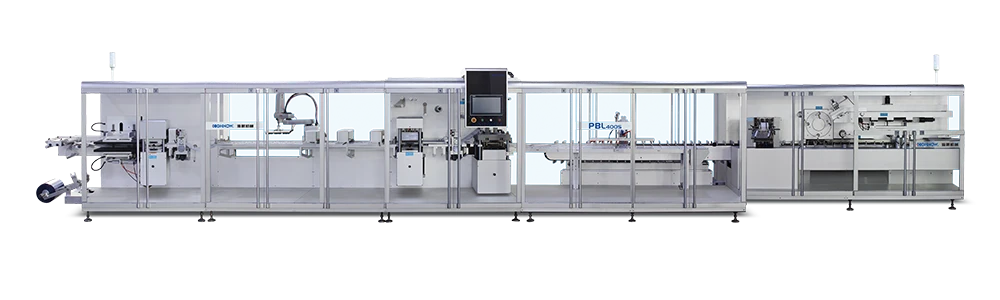
A vial blister packaging line typically consists of three zones:
- Upstream: vial filling, capping, labeling, and accumulation
- Core: blister forming, vial loading, sealing, and punching
- Downstream: cartoning, leaflet insertion, bundling, case packing, and palletizing
Each zone has its own control system. The integration challenge is to synchronize speed, handle rejects, and share production data without creating bottlenecks.
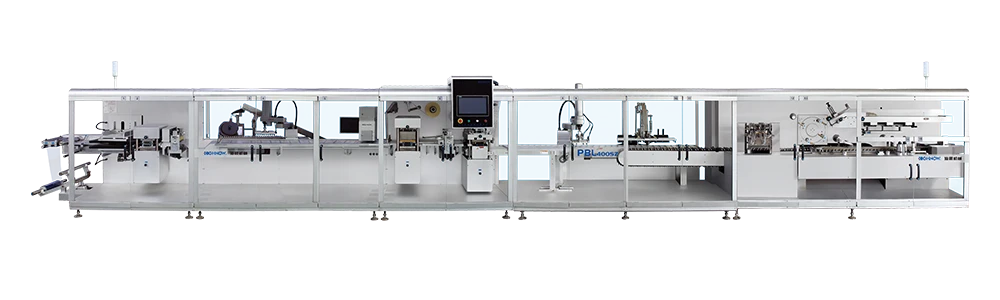
For a detailed view of the core blister module, review the available blister line configurations.
Upstream Filler Integration
The upstream filler determines the incoming vial flow. If the filler and blister line are not synchronized, you may see starved infeed, overflow, or vial damage.
Key integration points:
- Buffer design: Use accumulation tables or conveyors to absorb short stops.
- Signal exchange: Start/stop, speed reference, fault, and ready signals.
- Reject handling: Vials rejected by the filler should not enter the blister line.
- Speed matching: The blister line should run at a speed that matches the filler’s sustainable output.
A typical interface list includes:
| Signal | Direction | Purpose |
|---|---|---|
| Filler ready | Filler → Blister | Permits blister line start |
| Blister ready | Blister → Filler | Permits filler start |
| Speed reference | Blister → Filler | Matches output |
| Fault | Both ways | Stops upstream/downstream |
| Vial present | Filler → Blister | Confirms infeed |
| Reject | Blister → Filler | Signals rejected vial |
Downstream Cartoner and Case Packer Integration
Downstream integration focuses on smooth product transfer and data traceability.
For cartoning, the blister line must deliver blisters at the correct pitch and orientation. The cartoner then opens the carton, inserts the leaflet, loads the blister, and closes the carton. If the cartoner stops, the blister line should pause or divert product to a buffer.
For case packing, the cartoner output must match the case packer infeed. The case packer erects the case, loads cartons, seals, and discharges. Integration signals include carton ready, case ready, and fault.
You can review typical downstream equipment at the automatic cartoning machine and automatic case packer.
PLC, OPC UA, and MES Data Flow
Modern packaging lines use PLCs from Siemens, Rockwell, or Mitsubishi. Data exchange between machines often uses EtherNet/IP, PROFINET, or OPC UA. For pharmaceutical lines, 21 CFR Part 11 compliance requires audit trails, electronic signatures, and secure data storage.
A practical data flow:
- PLC level: Controls machine motion, interlocks, and safety.
- SCADA level: Collects OEE data, alarms, and batch records.
- MES/ERP level: Receives production orders, batch numbers, and quality results.
OPC UA is often used for vertical communication because it is platform-independent. When specifying a line, confirm:
- PLC brand and model
- Supported communication protocols
- Data points available for OEE
- Audit trail capability
- User access control
- Electronic signature support
OEE Calculation and Improvement
OEE = Availability × Performance × Quality.
- Availability: Actual run time ÷ planned production time
- Performance: Actual output ÷ theoretical maximum output
- Quality: Good units ÷ total units
For a vial blister line, measure OEE over a defined period (e.g., one shift or one batch). Use the same definition when comparing suppliers.
Typical improvement levers:
| OEE factor | Common loss | Improvement action |
|---|---|---|
| Availability | Changeover, breakdown, cleaning | SMED, preventive maintenance, quick-release tooling |
| Performance | Speed loss, minor stops | Servo tuning, buffer optimization, feeder synchronization |
| Quality | Rejects, rework | Vision inspection, leak testing, weight check |
A validated line may target OEE ≥ 88% under defined conditions. Actual results depend on product format, batch size, shift pattern, and operator skill. Verify OEE through a factory acceptance test and a performance qualification run.
Quick Changeover SMED
Changeover time directly affects availability and OEE. Use SMED principles:
- Separate internal and external tasks: Prepare tools and parts before stopping the line.
- Convert internal to external: Pre-heat molds, pre-stage cartons, pre-fold leaflets.
- Simplify internal tasks: Use quick-release clamps, color-coded parts, and recipe-driven servo adjustments.
- Standardize: Document changeover steps and train operators.
A typical changeover checklist:
- Select recipe on HMI
- Confirm vial format and blister layout
- Change forming mold and sealing platen
- Adjust feeder rails and pushers
- Load new carton and leaflet
- Run first-article inspection
- Record changeover time
For feeder changeover, review the small bottle feeder options.
Line Acceptance Testing
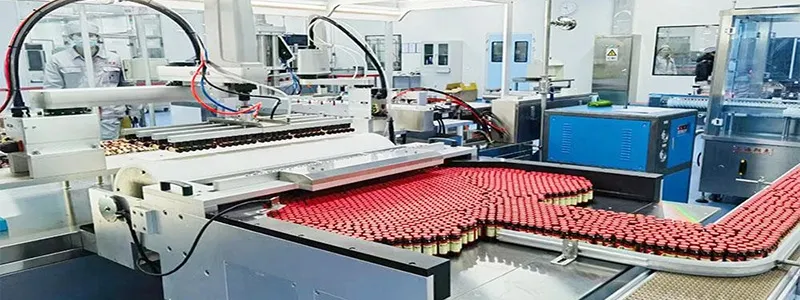
Before shipment, conduct a factory acceptance test (FAT). After installation, conduct a site acceptance test (SAT). Key metrics:
| Test item | Target | Method |
|---|---|---|
| Speed | Rated cycles/min | Run at full speed for 30 min |
| OEE | ≥ 88% under defined conditions | 4-hour continuous run |
| Reject rate | ≤ 0.1% for glass vials | Count rejects |
| Changeover time | ≤ 15 min | Time for full format change |
| Seal integrity | Per USP <1207> | Dye or vacuum test |
| Data integrity | 21 CFR Part 11 | Audit trail review |
Vial Blister Line Integration & OEE FAQ
How do you synchronize a vial blister line with an upstream filler?
Use buffer accumulation, speed reference signals, and ready/fault interlocks. The blister line should run at a speed that matches the filler’s sustainable output.
What is a good OEE target for a vial blister line?
A validated line may target OEE ≥ 88% under defined conditions. Actual OEE depends on product format, batch size, shift pattern, and maintenance.
Which communication protocol is best for packaging line integration?
OPC UA is often used for vertical data exchange because it is platform-independent. EtherNet/IP and PROFINET are common for machine-to-machine communication.
How can changeover time be reduced?
Apply SMED: separate internal and external tasks, convert internal to external, use quick-release tooling, and standardize procedures.
What should be included in a line acceptance test?
Speed, OEE, reject rate, changeover time, seal integrity, and data integrity. Document all results and deviations.
Conclusion
Integrating a vial blister line requires synchronized upstream and downstream equipment, reliable PLC and OPC UA data flow, and disciplined OEE management. Focus on buffer design, signal exchange, quick changeover, and acceptance testing. When the integration plan is complete, review the available blister lines for vial product configurations and discuss your production requirements with our engineers on the contact page.