English
 Pусский
 Español
You have a budget. You have a production timeline. And you have a quote for a vial blister machine that looks remarkably affordable. The procurement team is pleased. The CFO is nodding. It seems like a smart move.
But here is the question that gets asked only after the machine is installed: what did that "saving" actually cost you?
In pharmaceutical packaging, the lowest invoice is almost never the cheapest option. The real price of a vial blister machine is not the number on the quote—it is the total cost of ownership over the machine's operational life. And cheap machines have a way of making that number very large, very quietly.
This guide uncovers five hidden costs that cheap vial blister machines carry—costs that don't appear on the invoice but will appear on your P&L.
The Iceberg: What the Quote Doesn't Tell You
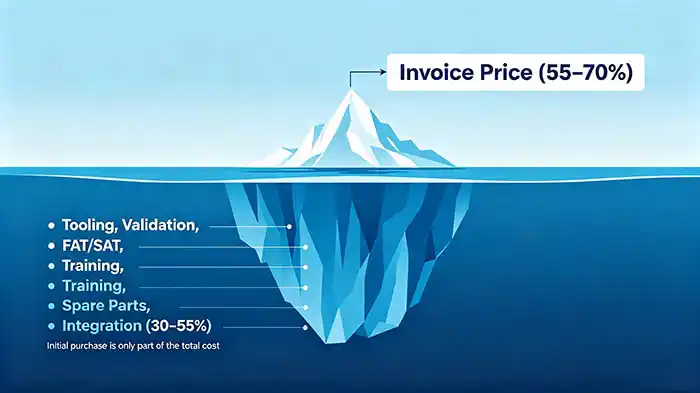
The purchase price of a vial blister machine is the tip of the iceberg. What lies beneath is substantially larger.
A liquid blister packaging machine for pharmaceutical use might carry a base price of $25,000 to $85,000. But the total cost of ownership—including mold tooling ($3,000–$18,000), IQ/OQ/PQ validation ($8,000–$30,000), FAT/SAT ($4,000–$12,000), PLC integration, and annual spare parts—typically runs 30 to 55% above the invoice price. For syringe blister packing machines, the total cost of ownership runs 1.8× to 2.4× the quoted price when validation, tooling, and compliance documentation are properly accounted for. In broader pharmaceutical packaging, the machine price alone represents only 55–70% of total project cost—tooling, integration, validation, operator training, and spare parts consistently add another 40–80% on top.
What this means for you:
A $40,000 price gap between two machines means nothing if the cheaper unit ships without validation documentation, without proper FAT/SAT, and with a control system that cannot be integrated into your existing MES. The "saving" disappears in the first month of commissioning—and then some.
Cheap machines achieve their low price points by engineering out reliability and efficiency, effectively transferring costs from your capital budget to your operational budget. What looks like a saving on day one becomes a recurring expense for years to come.
To understand how different vial blister packaging lines are configured for long-term reliability, explore packaging solutions designed for sustained pharmaceutical production.
The Downtime Tax
Every minute a packaging line is stopped is a minute of lost production. But the real cost of downtime goes far beyond lost output.
The numbers:
Unplanned downtime on a pharmaceutical packaging line can cost $5,000 to $20,000 per hour per line. On a high-speed blister line, a single unplanned stoppage can cost $180,000 per hour** in lost output and batch write-off. Over a year, eight lost days of packaging can represent an opportunity cost of **up to $1,170,000.
Why cheap machines fail more often:
Cheap machines rely on cheaper materials and poorly designed components. They break down more frequently. Sealing temperature control drifts. Feeding systems jam. PLCs trigger cascade faults. The primary causes of blister packaging line downtime include material changeovers, blister sealing failures, mechanical wear in feeding systems, foil splicing delays, temperature control inconsistencies, and inadequate preventive maintenance protocols. Each of these problems is amplified in lower-quality equipment.
What this means for you:
A machine that costs 30% less but breaks down twice as often is not a saving—it is a liability. Every unplanned stop disrupts production schedules, delays shipments, and potentially damages client relationships. The cost of emergency repairs and rush orders for replacement parts can be substantial. And the stress placed on your production team is real but uncounted.
The Reject Rate Drain
A 2% reject rate sounds trivial. It is not.
On a 300-card-per-minute machine running 16 hours, a 2% reject rate means 5,760 cards discarded every single day. Over a month, that is over 170,000 wasted cards—and wasted vials, wasted film, wasted labor.
The compounding effect:
Reject rates do not just reduce output—they consume production capacity. Every rejected blister represents material that was formed, filled, sealed, and inspected, only to be discarded. Inconsistent seal integrity creates rejection rates that consume production capacity while generating rework costs and material waste.
Low-end machines often rely on cheap materials and poorly designed components. This leads to inconsistent sealing, forming defects, and higher reject rates. A machine that looks cheaper at first can become more expensive if it wastes material.
What this means for you:
Over a year, even a 1% difference in reject rate translates into tens of thousands of dollars in wasted product and materials. For high-value parenteral products—where each vial may represent significant drug value—the cost of rejections escalates even faster. A line designed for precision and consistency pays for itself through lower reject rates alone.
The Compliance Gap
Pharmaceutical packaging is not optional. Neither is compliance.
The regulatory reality:
A $28,000 unit with missing GMP documentation can cost you a market authorization. If your machine cannot produce a complete, unmodified electronic batch record with every parameter change and timestamp, your line is not 21 CFR Part 11 compliant—regardless of what the vendor's brochure says.
The lowest quote in your inbox is not the cheapest option—it is almost certainly the most expensive one, once you account for revalidation costs, line downtime, and the professional fees of a compliance consultant hired to reverse-engineer documentation that was never planned to exist.
Common compliance failures in cheap machines:
-
No IQ/OQ/PQ documentation: The machine ships without the validation package required for GMP environments.
-
Proprietary PLC protocols: The control system uses a proprietary communication stack that blocks OPC-UA integration with your MES.
-
Hard-coded parameters: Critical parameters are hard-coded in ladder logic, not accessible from the HMI—meaning every batch record deviation requires a PLC engineer on-site.
-
No audit trail: The system cannot produce the audit trail required by 21 CFR Part 11.
What this means for you:
Regulatory non-compliance can delay product launches, trigger regulatory inspections, or worse. A vendor that focuses solely on upfront pricing is a red flag that they may not be considering the full financial picture. The cost of fixing compliance gaps after delivery far exceeds the cost of specifying them correctly from the start.
For packaging solutions designed with compliance and validation in mind, explore how vial blister lines are engineered for GMP, FDA, and CE requirements.
The Parts and Service Trap
Every machine needs spare parts. Every machine needs maintenance. But not every machine makes parts and service accessible—or affordable.
The reality of cheap machines:
Cheap machines often use proprietary, non-standard components that are difficult to source. When a part fails, you are locked into the original supplier—at whatever price they choose to charge. Lead times can stretch from days to weeks. And if the supplier is no longer in business, you may be left with an expensive paperweight.
Annual maintenance contracts typically run at 18–20% of system value. For a cheap machine, that percentage may be the same—but applied to a lower base value, the absolute spend might seem lower. However, the frequency of repairs on cheap machines is substantially higher, and the cost of emergency parts and expedited shipping can quickly erase any perceived saving.
What this means for you:
A machine with readily available spare parts, clear maintenance protocols, and responsive after-sales support minimizes downtime. A machine without these things maximizes it. When evaluating equipment, look beyond the machine itself—assess the supplier's service network, spare parts availability, and commitment to long-term support.
The True Cost Comparison
| Cost Category | Cheap Machine | Quality Machine | The "Cheap" Penalty |
|---|---|---|---|
| Purchase price | Lower | Higher | Initial saving |
| Validation (IQ/OQ/PQ) | Often missing—costs more to retrofit | Included or clearly specified | $8,000–$30,000+ |
| Tooling & molds | Often excluded from quote | Clearly specified | $3,000–$18,000+ |
| Unplanned downtime | Frequent and costly | Minimized through reliability | $5,000–$20,000/hour |
| Reject rate | 3–5% or higher | 1–2% or lower | Tens of thousands/year |
| Compliance risk | High—may fail audit | Built-in compliance | Market authorization at stake |
| Spare parts | Hard to source, long lead times | Readily available | Days of downtime |
| Total Cost of Ownership | 1.8×–2.4× invoice price | Predictable and manageable | The real cost |
Actual Application Scenarios
A mid-sized pharma company choosing the lowest bidder
A pharmaceutical manufacturer selects a vial blister machine based solely on the lowest quoted price—$45,000 versus competitors at $68,000 and $72,000. The machine arrives without IQ/OQ/PQ documentation. The PLC uses a proprietary protocol that cannot connect to the MES. Sealing temperature control drifts during production, causing a 5% reject rate. Within six months, the company has spent $22,000 on a compliance consultant to reverse-engineer documentation, lost 80 hours of production to unplanned downtime, and wasted thousands of dollars in rejected vials. The "saving" has become a loss.
A CMO prioritizing total cost of ownership
A contract manufacturing organization evaluates vial blister machines using a total cost of ownership framework. They request full validation documentation, witness a 4-hour FAT at rated speed, and verify OPC-UA integration with their MES. The machine they select costs more upfront but delivers consistent output, low reject rates, and seamless compliance documentation. Over five years, the TCO is substantially lower than the cheapest option—and the line passes every regulatory inspection without issue.
For customized packaging solutions that prioritize long-term value over short-term price, explore how vial blister packaging lines are configured for your specific production requirements.
Next Steps: From Price to Value
The cheapest vial blister machine is almost never the least expensive one. The real cost is in downtime, rejects, compliance failures, and unplanned expenses that appear long after the invoice is paid.
When evaluating equipment:
-
Request a complete cost breakdown—including tooling, validation, FAT/SAT, and training.
-
Demand compliance documentation—IQ/OQ/PQ, 21 CFR Part 11 readiness, and open PLC architecture.
-
Witness a full FAT—not a 30-minute demo, but a witnessed stress test at rated speed.
-
Verify after-sales support—spare parts availability, service response times, and remote diagnostics.
-
Calculate total cost of ownership—not just purchase price, but maintenance, downtime, energy, and reject costs over five years.
Once you have clarified these decision factors, comparing the specific capabilities of available packaging solutions becomes the next logical step. You can review HIGHNOW's vial blister packaging lines, which are engineered with compliance-ready control architecture, validated documentation packages, and modular designs for long-term reliability—or explore customized configurations for specialized applications.
For additional guidance on evaluating pharmaceutical packaging equipment, read our related guide on what to know before investing in a vial blister line.
Related Reading
-
How Does a Vial Blister Packaging Line Work? – A Step‑by‑Step Guide
-
What to Know Before Investing in a Vial Blister Line
-
Vial Breakage on Blister Lines? Causes and Fixes
-
5 Tips to Choose a Vial Blister Packaging Machine
-
The Science Behind Blister Seal Integrity Testing
This article is part of HIGHNOW's technical content library. No direct sales or pricing information is included. All technical discussions aim to help you make informed purchasing decisions.