English
 Pусский
 Español
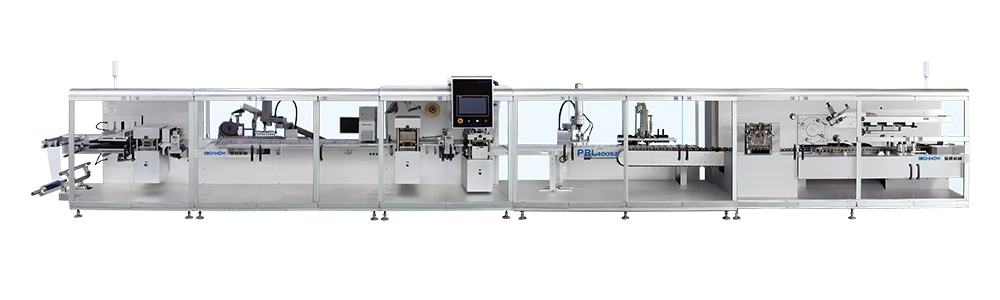
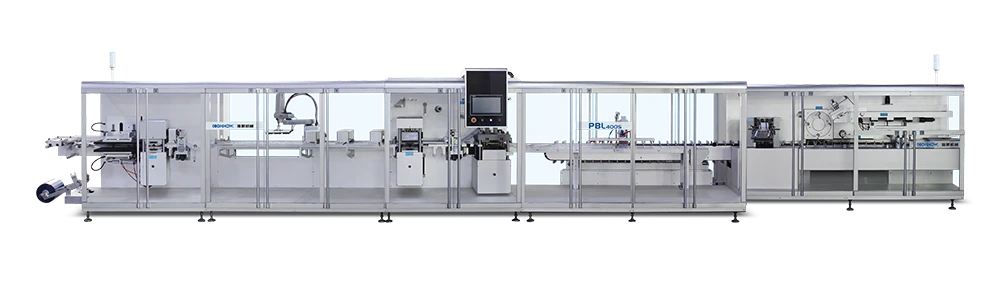
A vial blister packaging line forms a pocket in a plastic or aluminium web, seats a filled and stoppered vial into the nest, seals lidding over it, punches the card out and hands it to a cartoner. What separates two lines is not the headline speed but twelve specification inputs: container drawing, nest count, film structure, carton style, batch size, cleanroom class, utilities, target output, target OEE, validation scope, and destination conditions. This guide works through them in the order a real project meets them.
What a vial blister line does, and what it does not do
The line turns a continuous web into a printed card that carries one or more vials, then hands that card to cartoning. Upstream of the sealing station, the job is to protect the container; downstream of it the job is to protect the output rate. Buyers who mix the two end up with a line that is either gentle and slow or fast and rough.
- Forming: the web is heated and drawn into a cavity, usually with vacuum or compressed air plus a plug assist.
- Loading: vials arrive from a cassette, a vibratory bowl or an inline feeder, and are placed into the pocket or nest.
- Sealing: lidding is bonded to the web by a roller or a platen at a controlled temperature, pressure, and dwell time.
- Punching: a blanking tool with print registration cuts the individual card free of the web.
- Transfer: the card is oriented and fed into the cartoner, which is the point where most output is lost.
Three things it is not. It does not fill vials: product filling, stoppering and capping belong to an aseptic or terminal-sterilisation line that sits upstream. It does not sterilise: the blister protects a container that arrives already clean or already sterile, depending on the process design. And it is not a cartoner with a blister feeder added on: nesting, transfer and card orientation are engineering problems in their own right, and they are where the specification usually goes thin.
The distinction has a commercial consequence. Two quotations for a "vial blister line" can describe different scopes: one includes forming, sealing, punching and transfer; the other starts at the cartoner infeed. Comparing them without a scope annex is the single most common source of a change order later. The equipment scope itself is set out on the pages for available vial blister line configurations; this guide is about the decisions behind it.
Configuration: rotary, inline or hybrid
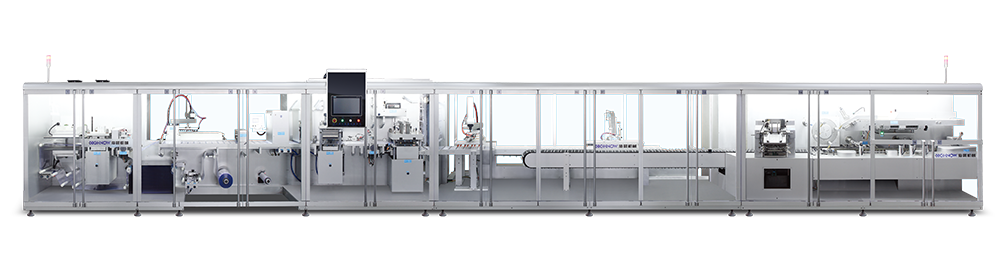
Configuration is decided by two facts, not by a preference for speed: how many formats you will run in a year, and how many units go into each batch. A rotary cam-driven frame gives stable motion and predictable output, but its changeover is long, and its economics assume one or two dominant formats. An inline indexing frame is easier to access and faster to change, and it gives up some rate to do it. A hybrid keeps rotary forming and moves loading and cartoning inline, which suits portfolios that mix high-volume and short-run formats.
| Configuration | What it does well | Where it constrains you | Fits when |
|---|---|---|---|
| Rotary | Stable motion, repeatable sealing, high sustained output | Long changeover, large footprint, format changes cost production days | One or two formats, long runs, output is the deciding constraint |
| Inline | Open access, quick format changes, easier cleaning and inspection | Lower ceiling on rate, more sensitivity to transfer timing | Many formats, short campaigns, contract manufacturing |
| Hybrid | Rotary forming quality with inline loading and cartoning | More interfaces to specify and to validate | Mixed portfolio: one high-volume format plus seasonal or trial formats |
The practical test is arithmetic, not intuition. Multiply the annual unit volume by the number of formats you expect to change over in a month. If changeover hours per month exceed the hours you would save by running faster, the rotary frame is the wrong purchase no matter how good its nameplate looks. Ask each supplier to quote changeover time as a number of hours with a named crew size, and hold them to it at acceptance.
Container compatibility starts with the drawing, not the machine
A blister frame is adaptable, but only within the limits of the nest and the transfer. Vial diameter, height, neck finish and weight variation decide whether a pocket holds the container firmly enough at speed and gently enough to avoid scuffing or breakage. Moulded and tubular glass behave differently here: moulded vials vary more in diameter and weight, which shows up first as mis-nesting and double feeds. Dimensional references for injection vials and closures are set out in the ISO 8362 series; ask for the supplier's drawing against those sizes rather than a nominal description.
| Container | Feed method | Nest or cavity concern | Main risk | Changeover impact |
|---|---|---|---|---|
| Injection vial | Cassette or vibratory feeder with escapement | Retention over diameter and weight variation | Mis-nesting, double feed, surface scuffing | Nest set plus feed rails |
| Ampoule | Rail transfer or dedicated nest | Support below the break ring | Breakage at neck during transfer | Full tooling set, requalification |
| Cartridge | Oriented magazine or pick-and-place | Flange location, orientation | Wrong orientation, flange damage | Nest, orientation guide, sensors |
| Prefilled syringe | Nest-to-nest transfer | Backstop and plunger-rod clearance | Rod displacement, sterility breach | Nest, backstop, transfer tooling |
| Oral liquid bottle | Inline screw or star wheel | Base support, cap clearance | Leakage, cap scuffing | Pockets, capping interface |
| Special-shaped or kit | Manual or semi-automatic loading | Multiple cavities per card | Mixed-component mismatch | New cavity plate per kit |
The commercial point is that a frame able to run six formats is really six tooling kits and six requalification scopes. When a supplier says the line is "multi-format", the follow-up question is how many format kits are included, how long a kit takes to fit, and which validation documents have to be revised each time a new container is introduced. If those three answers are not in the quotation, the flexibility is theoretical. For containers outside the standard nest range, the vial feeding and cassette systems carry most of that risk, and they are worth specifying at the same time as the nest.

The twelve inputs that decide the line
Most specification mistakes are not technical. They are inputs that were never written down, so the supplier filled the gap with an assumption and the buyer inherited it. The twelve items below are the minimum set; each one changes a mechanical decision, not just a document.
| Input | Format | What it decides | Typical mistake |
|---|---|---|---|
| Container drawing | mm, with tolerances | Nest geometry, cavity depth, transfer height | Working from a photograph or a catalogue page |
| Nest count | cavities per stroke | Strokes per minute for a given output | Sizing on nameplate speed instead of nest arithmetic |
| Film structure and thickness | microns, gsm, structure | Forming depth, seal window, punch behaviour | Selecting on price per kilogram |
| Print and registration | Position, stretch allowance | Punch tolerance, card appearance | Ignoring print stretch across the web |
| Carton style and size | mm, board grade | Cartoner type, infeed orientation | Designing the carton after the line is ordered |
| Batch size | units per batch | Changeover economics, buffer sizing | Ignoring how many formats a year will run |
| Cleanroom class | ISO 14644 class | Machine finish, air handling, gowning | Setting the class from the room, not from the process |
| Utilities | Air, power, chilled water | Site readiness, compressor sizing | Discovering air demand during installation |
| Target output | units per hour | Frame size, nest count, buffer volume | Setting a round number nobody has checked |
| Target OEE | percent | Buffers, staffing, acceptance criteria | Assuming one hundred percent availability |
| Validation scope | IQ, OQ, PQ, documents | Documentation load, project duration | Agreeing scope after the purchase order |
| Destination conditions | Voltage, frequency, climate | Electrical specification, cooling capacity | Assuming the supplier's domestic standard |
Two of these deserve a worked example, because they are the ones buyers most often leave to the supplier. Take a target of 8,000 vials per hour on a four-cavity nest at an assumed 85 percent OEE. The required mechanical rate is 8,000 divided by four, divided by 0.85, which comes to roughly 2,350 strokes per hour, or about 39 strokes per minute. At 90 percent OEE the same target needs 37; at 75 percent it needs 44. That spread is not cosmetic: it decides whether a given frame can serve the target at all, and it is exactly the arithmetic a supplier will do privately if the buyer does not.
The second example is the buffer. If the cartoner stops for thirty seconds and the blister machine does not, the cards that arrive during that stop have to go somewhere. Thirty seconds at 39 strokes per minute is about twenty cards. Size the accumulation accordingly, and write the assumption into the acceptance criteria so the buffer is tested at FAT rather than discovered in production.
Film structure and forming decisions
Barrier requirement comes first, cost second, and the two are not as far apart as buyers expect. PVC is the conventional choice for products that tolerate moderate moisture transmission and is easy to form at speed. PVC with a PVDC coating extends barrier without changing the forming behaviour much. COC offers a different balance of barrier, neutrality and forming, and is worth evaluating where product contact or extractables are under review. Aluminium-aluminium cold form gives the highest barrier of the four and forms by cold working rather than heating, which changes the machine's energy profile and the tooling loads.
| Structure | Barrier | Forming behaviour | Suits | Watch |
|---|---|---|---|---|
| PVC | Moderate moisture barrier | Heated, deep draw with plug assist | Short-shelf-life, moisture-tolerant products | Plasticiser migration questions, market acceptance |
| PVC with PVDC coating | Improved moisture and gas barrier | Similar to PVC, tighter seal window | Mid-shelf-life products | Coating integrity at the seal edge |
| COC | Good moisture barrier, low extractables profile | Narrow forming window, sensitive to temperature control | Products with extractables or clarity requirements | Film availability in the required thickness |
| Alu-alu cold form | Highest barrier of the four | Cold forming, high tooling force, no heating | Moisture- or oxygen-sensitive products | Pinholes, forming depth limits, energy profile |
Three details decide whether the chosen structure survives production. Seal lacquer compatibility with the lidding, and with the container if the lidding contacts it, has to be confirmed in writing by the film supplier. Forming depth must clear the vial plus the headspace the process requires, not the vial alone. And machine direction versus transverse direction matters for print registration and for how the web behaves when it is drawn: a structure that forms well in one direction can wrinkle in the other.
Scrap is the cost item buyers underestimate. Offcut from the punch, trim at start-up, and rejected cards during a format change all consume film at the price of the most expensive material on the line. Ask for the scrap rate as a percentage of web consumed, per format, and multiply it by the annual volume before comparing film prices.
Cartoning and end-of-line: where the output disappears
A blister line and a cartoner are usually bought from different suppliers, sized by different people, and commissioned a month apart. That is how a line that tested at its target in isolation runs below target in production. The rule that prevents most of it is simple: cartoner capacity should exceed blister output by eight to twelve percent, so that format stops, card rejects and transfer hiccups are absorbed by the cartoner's own buffer rather than by stopping the upstream machine.
Between the two machines there are three buffer options. An accumulation table holds a fixed number of cards and gives the operator time to clear a cartoner jam without stopping forming. A conveyor loop carries more volume but takes floor space and adds a second place where cards can fall or jam. A manual tray is acceptable for low output or for formats with heavy manual inspection, but it turns output into a labour variable. Whichever is chosen, the buffer needs a defined capacity, a full-buffer sensor and a stop logic that is tested at FAT.
Downstream of the cartoner, the same arithmetic repeats with cases and pallets. Cartons per case, cases per layer and layers per pallet fix the case packer and palletiser rates, and those rates fix how much accumulation is needed at each transfer. A line balanced only at the front is a line that stops at the back. The cartoning and end-of-line options are worth reviewing alongside the blister machine rather than after it, because the interfaces are the part nobody wants to own.
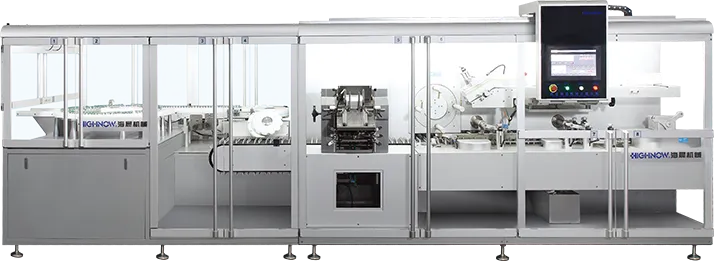
One more interface belongs here rather than in the compliance discussion: the point where a code is applied and read. Whether the carton carries a printed code, a label or an aggregated case code, the station that applies it sits between the blister transfer and the cartoner infeed, and it adds a reject path that has to be wired back to the blister machine's reject gate. Specify it late and the line ends up with a camera watching cards the punch has already discarded.
OEE, changeover and the operator model
OEE is availability multiplied by performance multiplied by quality, and on vial lines the three losses are not equal. Availability loss dominates when changeover is long and format parts are numerous. Performance loss dominates when nests mis-feed, when the transfer runs below its design rate, or when the cartoner is the real constraint. Quality loss dominates when sealing is marginal and cards are rejected at the punch. Measuring the three separately, for two weeks, tells you which investment is worth making: a second format kit, a better feeder, or a tighter seal window.
Changeover is the most improvable of the three, and it responds to method more than to money. External setup, where every format part and tool is staged before the machine stops, usually removes more time than any hardware change. Quick clamps and numbered kits remove the trial-and-error fitting that consumes the middle of a changeover. A documented first-article check, with the same three measurements every time, removes the slow restart at the end. The target that most projects can defend is a changeover short enough that the batch size still makes sense: if the format runs for two hours, a ninety-minute changeover is not a scheduling problem; it is a design problem.
Staffing follows the same logic. Every step that is still manual, from loading special-shaped containers to clearing cartoner jams, is a person on the shift. A line that needs two operators per shift costs more over seven years than the difference between two quotations, which is why the operator model belongs in the TCO and not in the commissioning report.
The validation path, in the order documents are signed
Validation is a sequence of documents, each of which closes a question before the next one opens. Buyers who treat it as paperwork to be produced at the end usually find that the equipment cannot produce the evidence they need, because the requirement was never written into the purchase.
- URS, written by the buyer, states what the line must do and under which conditions. It is the reference for every later document.
- DQ, written by the supplier, shows how the design meets each URS item, including the ones it does not meet.
- FAT, run at the supplier's site against a protocol agreed before the order, proves the line at defined conditions with defined material.
- SAT, run on site, proves the line in its actual room, with actual utilities and actual operators.
- IQ and OQ, normally supported by the supplier and signed by the buyer, prove installation and operation against the specification.
- PQ, written and executed by the buyer, proves the line in routine production across the format range it will actually run.
Two practical rules shorten this path. Agree the validation scope, including who writes which document and who signs it, before the purchase order rather than during commissioning. And define the FAT protocol around the numbers in the URS: strokes per minute at a stated OEE, seal strength at stated limits, reject rate at a stated sample size. A FAT that tests "general operation" produces a report nobody can defend later. The quality documentation that supports these steps sits on the site's quality pages; the guide here is about sequencing them so they do not become a second project.
Seven-year TCO: what makes two quotations incomparable
Two quotations that differ by a wide margin are rarely describing the same object. The difference is usually scope that one includes and the other leaves to the buyer: format kits, spare parts, training days, commissioning support, freight, and the validation documents. Normalising the quotes before comparing them is more valuable than negotiating, because it changes what you are buying.
| Cost item | What drives it | Where quotes diverge |
|---|---|---|
| Capital | Frame size, nest count, number of stations, controls | Forming and sealing scope included or excluded |
| Format parts | Number of formats, kit design, spare kits | One kit versus two, and whether kits are priced per format |
| Energy | Heating, vacuum, compressed air, chiller load | Cold form versus thermoform, air consumption per cycle |
| Labour | Manual steps per shift, changeover crew, inspection | Automation level at loading and at transfer |
| Downtime | Changeover hours, MTTR, spare parts on site | Spare parts package and response commitment |
| Consumables | Film price, scrap rate, lidding, cartons | Scrap allowance and film structure assumed |
| Validation and training | Document set, protocol support, operator days | Documents delivered as templates versus executed |
Build the model with your own numbers and the suppliers' quoted figures, and keep the assumptions visible. The output is not a single number: it is the ranking of the three or four items that dominate, and the knowledge of which of them the supplier controls. A worked cost model for a vial blister line, with the sensitivity to shift pattern and format count, is set out in the existing TCO analysis; the point here is that the comparison has to be made before the order, not after the first year of operation.
One decision inside the stack is worth making explicitly: how many format kits to buy. A second kit for the highest-volume format lets one kit be cleaned or repaired while the other runs, which turns a maintenance stop into a changeover. On a format that runs a few days a year, the second kit is idle capital; on the format that runs twenty weeks it usually pays for itself in avoided downtime. Buy kits by format volume, not by format count.
Failure modes and the design changes that prevent them
Every vial blister line has the same short list of recurring failures. None of them is solved by operating more carefully; each is solved by a design decision that costs less at the specification stage than at any later stage.
| Failure | Symptom | Usual cause | Design countermeasure |
|---|---|---|---|
| Vial breakage at loading | Glass fragments in the pocket, rejects after sealing | Impact at the drop point, insufficient support below the body | Lower the drop height, add a guided chute, support the vial body rather than the shoulder |
| Seal leak | Failed integrity test, weak peel values | Marginal temperature or pressure at the seal edge, contaminated seal area | Wider seal window, edge cleaning, platen rather than roller where geometry allows |
| Mis-nesting and double feed | Two vials in one nest, crushed card | Diameter and weight variation, escapement set for nominal size | Escapement with mechanical gauging, nest retention sized to the tolerance band |
| Punch burr and registration drift | Damaged edges, print off centre | Worn punch, web stretch not compensated | Hardened punch inserts, registration sensor with stretch compensation |
| Cartoner jam at transfer | Cards stacked at infeed, machine stops | Transfer timing, orientation, buffer too small | Defined buffer capacity, orientation check, transfer timed from the cartoner not the blister |
| Film wrinkle and surface marks | Cosmetic rejects, seal inconsistency | Forming temperature profile, web tension | Zone-controlled heating, tension control, plug assist matched to depth |
The pattern in the table is that countermeasures are mechanical and early. A guided chute is cheap before the frame is built and expensive afterwards. A registration sensor with stretch compensation is a control option at order and a retrofit at year two. This is the practical argument for spending the specification phase on the container drawing, the nest and the transfer rather than on the headline rate.
The same argument applies to spares. A criticality list ranked by the hours a line would stand still without the part is more useful than a price list, and it decides whether a first-year stoppage is measured in hours or in weeks. Ask for the list with lead times attached; a supplier who cannot produce one has usually not thought about the second year of ownership.
How to evaluate a supplier in one visit
Supplier evaluation is usually conducted as an interview, which rewards the better presenter. It is more reliable to conduct it as an inspection of decisions the supplier has already made. Five questions separate an assembler from a manufacturer, and none of them can be answered with a brochure.
- Ask to see the nest and cavity design for a container close to yours, and ask what tolerance band it was sized for.
- Ask which stations are built in-house and which are bought in, then ask to see the built ones.
- Ask for the changeover time as hours and crew size for a named format change, and for the format-part list that achieves it.
- Ask which validation documents the supplier writes, which it supports and which the buyer must write.
- Ask for the spare-parts list by criticality, not by price, and for the MTTR assumption behind it.
On a reference-line visit, watch three things rather than listen to three opinions. How the operator clears a jam tells you whether the machine was designed for access. How the format parts are stored tells you whether changeover is a method or an improvisation. And how the line is instrumented tells you whether the OEE figures you were quoted can be measured at all.
Specification readiness checklist
Before an RFQ goes out, the following should be answerable in writing. If any item is open, the quotation will contain an assumption instead of an answer.
- Container drawing with tolerances, for every format in the first three years.
- Nest count and the resulting strokes per minute at the target OEE.
- Film structure, thickness and print stretch allowance.
- Carton style, board grade and infeed orientation.
- Annual volume, batch size and the number of format changes per month.
- Cleanroom class and the machine finish it implies.
- Available air, power and chilled water, with the site's actual values.
- Target OEE and the acceptance tests that will prove it.
- Validation scope, with named document owners.
- Destination voltage, frequency and climate conditions.
- Spare parts criticality list and the response time required.
- Buffer capacity between blister and cartoner.
Frequently asked questions
How many vials per minute can a vial blister line run?
Output is nest count multiplied by strokes per minute, adjusted for OEE, so the honest answer is a calculation rather than a number. A four-cavity nest at 39 strokes per minute yields about 156 cards per minute at full efficiency, and about 133 at 85 percent OEE. Ask any supplier to show the strokes-per-minute figure at the OEE they will guarantee at FAT.
Can one line run vials, ampoules and prefilled syringes?
Often yes within a diameter and height band, but the cost sits in tooling and requalification rather than in the frame. Each container needs its own nest or cavity set, its own feed and transfer parts, and a documented requalification of the affected parameters. Ask how many format kits are included and what each additional kit requires in validation documents.
Is PVC still acceptable for pharmaceutical blister packaging?
It depends on the product's moisture sensitivity and on the market's expectations, not on a general rule. PVC with a PVDC coating is common where moderate barrier is enough; COC and aluminium cold form are used where barrier, extractables or clarity requirements are stricter. Confirm the structure with the film supplier's data and with your quality function before the nest is designed.
What cleanroom class does blister packaging need?
For secondary packaging of already-stoppered containers, the class usually follows the room the line will occupy rather than the machine itself, and ISO 8 is a common starting point. Where the container is open, or the product is sterile and the blister is part of the sterile barrier, the requirement changes and must be set with quality assurance. Machine finish, cleaning access and air handling all follow from that decision.
How long does validation take from FAT to PQ?
It runs in months, not weeks, and the length is driven by document review and site readiness more than by test duration. The parts that most often extend it are unresolved FAT observations and PQ material that is not available when the line is. Sequence validation as a project phase with named owners, and agree the scope before the purchase order.
What should a FAT protocol contain for a blister line?
At minimum: the formats tested, the material lots used, strokes per minute at stated OEE, seal strength and integrity results at defined limits, reject rate at a stated sample size, changeover time with crew size, buffer capacity verification, and the list of open observations with owners. A protocol that only records general operation cannot support IQ or PQ later.
Conclusion
The three decisions that matter most are the container drawing, the nest arithmetic and the cartoner balance. Everything else on the line is adjustable later; these three are structural, and they are the ones that turn a quotation into a project.
The mistakes to avoid are equally consistent: sizing on nameplate speed instead of nest arithmetic, leaving changeover time as an adjective rather than an hours-and-crew number, and accepting an OEE target without an acceptance test that can prove it. Each of them is cheap to fix in the specification and expensive to fix in production.
Technical confirmation is needed whenever the container sits outside the supplier's standard nest range, whenever the product's barrier requirement is still under review, and whenever the destination's utilities differ from the supplier's domestic standard. In those cases, the drawing and the utility data should reach the supplier before the quotation, not after.
The next step is to put a container drawing and an output target in front of an engineer, and to ask for the strokes-per-minute figure and the format-part list in writing. That conversation is shorter than a quotation review, and it settles most of the scope. If it helps to start from the equipment side, review the available vial blister line configurations, or send your container drawing to our engineers, and we will work through the twelve inputs with you.