English
 Pусский
 Español
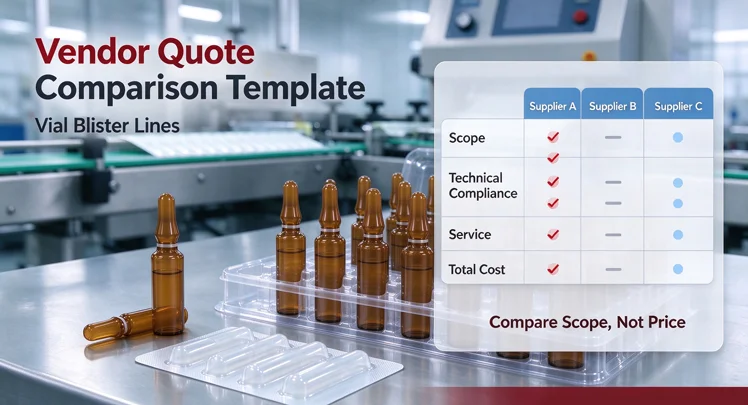
Comparing vial blister line quotes is not a price exercise. Two suppliers can quote similar headline numbers while delivering very different scope, support, and operating costs. The goal of a quote comparison template is to put every supplier on the same structure, expose missing items, and separate technical compliance from commercial terms. This guide provides a practical template, a technical compliance review method, and a checklist to identify quotes that look low but carry high total cost.
Why a Comparison Template Is Necessary
A supplier quote is written for the supplier's convenience, not yours. Each quote uses its own structure, its own scope boundary, and its own assumptions. If you compare quotes as they arrive, you are comparing formats, not value.
A comparison template fixes this by forcing every quote into the same rows. Once the rows are fixed, differences become visible:
- Which supplier includes tooling for all formats?
- Which supplier includes installation and commissioning?
- Which supplier includes validation documentation?
- Which supplier includes spare parts and service?
- Which supplier excludes items that will be needed later?
Scope Normalization: The First Step
Before comparing prices, normalize the scope. Use a fixed list of scope items and ask every supplier to confirm inclusion, exclusion, or optional.
| Scope item | Supplier A | Supplier B | Supplier C | Notes |
|---|---|---|---|---|
| Feeder | Model and capacity | |||
| Blister machine | Model and speed | |||
| Cartoner | Model and speed | |||
| Bundler | If applicable | |||
| Case packer | If applicable | |||
| Palletizer | If applicable | |||
| Conveyors and transfer | Length and type | |||
| Tooling and format parts | Count formats included | |||
| Safety systems | Guards, interlocks, light curtains | |||
| Controls and PLC | Brand, model, protocols | |||
| Data and audit trail | 21 CFR Part 11 support | |||
| Installation and commissioning | Days on site | |||
| Training | Hours, language, materials | |||
| Validation package | FAT, SAT, IQ, OQ, PQ | |||
| Documentation package | Drawings, manuals, certificates | |||
| Spare parts list | Recommended stock | |||
| Warranty terms | Duration and exclusions | |||
| Service contract | Response time, coverage | |||
| Utility requirements | Connected load, air, water | |||
| Format change support | On-site or remote |
Any row left blank is a question to ask the supplier. Any row marked "excluded" is a cost that will appear later. For the core line scope, review the blister lines for vial product range; for the machine-level scope, the automatic vial blister packaging machine page lists the main modules.

Technical Compliance Review
Price comparison comes after technical compliance. A quote that does not meet the technical requirement is not comparable, even if the price is lower.
A practical technical compliance review covers:
| Area | What to verify | Why it matters |
|---|---|---|
| Container range | Vial, ampoule, cartridge, syringe, oral liquid | Determines whether the line can run your product mix |
| Speed | Cycles per minute, plates per cycle, cartons per minute | Determines whether the line meets capacity |
| Format change | Time, tooling, recipe control | Determines changeover cost and flexibility |
| Sealing | Temperature control, pressure control, validation | Determines quality and compliance |
| Inspection | Vision, leak, weight, missing component | Determines reject detection capability |
| Data | PLC, OPC UA, audit trail, electronic signature | Determines 21 CFR Part 11 compliance |
| Cleaning | Material, surface finish, disassembly | Determines GMP cleaning feasibility |
| Utilities | Connected load, air, water, chilled water | Determines plant readiness |
| Safety | Guards, interlocks, CE compliance | Determines site acceptance |
For the cartoning and end-of-line scope, use the automatic cartoning machine and automatic case packer pages as the reference for module capability.
If a supplier's quote does not state a technical value, do not assume it meets the requirement. Ask for the value in writing.
Identifying Low-Price High-Cost Quotes
A low headline price is not a problem by itself. The problem is when the low price hides costs that appear after the contract is signed. Common patterns:
- Tooling included for one format only; other formats quoted separately
- Installation and commissioning excluded
- Validation documentation excluded
- Training limited to one session
- Spare parts list not included
- Service contract not included
- Utility requirements not stated
- Warranty excludes key components
- Software updates or license fees not stated
- Format change support charged per visit
A checklist to spot these patterns:
- Compare the scope table row by row
- Ask each supplier to state what is excluded
- Ask for the spare parts list and prices
- Ask for the service contract terms
- Ask for the utility requirement sheet
- Ask for the warranty exclusions
- Ask for the software and license terms
- Ask for the format change support terms
Organizing the Internal Review
A quote comparison is a team exercise. Assign owners to each section before the review meeting.
| Section | Owner | Output |
|---|---|---|
| Scope normalization | Procurement | Completed scope table |
| Technical compliance | Engineering | Compliance matrix |
| Cost model | Finance | Annual cost estimate |
| Validation and quality | QA | Documentation gap list |
| Service and spare parts | Maintenance | Service terms review |
| Commercial terms | Procurement | Payment, delivery, warranty review |
| Risk register | Project manager | Risk list with mitigation |
The review meeting should produce three outputs:
- A shortlist of suppliers that meet the technical requirements
- A cost comparison based on the same scope
- A risk list with mitigation actions
Building the Final Recommendation
The final recommendation should not be a single number. It should combine technical compliance, cost, risk, and service.
A practical recommendation structure:
| Criterion | Weight | How to score |
|---|---|---|
| Technical compliance | High | Pass or fail on mandatory requirements |
| 7-year TCO | High | Lower is better, with sensitivity range |
| Service and spare parts | Medium | Response time, availability, local support |
| Validation support | Medium | Documentation scope, audit support |
| Delivery and installation | Medium | Lead time, installation plan |
| Reference and experience | Medium | Similar projects, similar formats |
| Commercial terms | Low to medium | Payment, warranty, currency |
Weights should reflect the project priorities. A regulated market project may weight validation support higher. A multi-format project may weight changeover and format flexibility higher.
The recommendation should include:
- The recommended supplier and the reason
- The rejected suppliers and the reason
- The key assumptions and sensitivity results
- The risk register and mitigation actions
- The next steps and timeline
FAQ
How many suppliers should be compared?
Two to three suppliers is typical. More than three increases review effort without adding much new information, unless the suppliers represent very different technical approaches.
Should price be the first comparison?
No. Technical compliance comes first. A quote that does not meet the technical requirement is not comparable, even if the price is lower.
What is the most commonly missing item in a quote?
Tooling for additional formats, validation documentation, and spare parts lists are frequently missing or excluded. These should be confirmed in writing before comparison.
How do I compare quotes with different scope?
Normalize the scope using a fixed table. Ask each supplier to confirm inclusion, exclusion, or optional for every row. Then compare on the same basis.
Can I use the same template for different line sizes?
Yes. The template rows stay the same; the values change with the line size and product mix. The scope table should be updated for each project.
Conclusion
A vendor quote comparison template turns a confusing set of documents into a structured decision. Normalize the scope, review technical compliance, identify low-price high-cost patterns, organize the internal review, and build a recommendation that combines cost, risk, and service. Use the Blister Lines for Vial Product configuration range as the technical reference, and contact our engineers on the contact page if you need help confirming the scope.