English
 Pусский
 Español
Grade, airflow, and pressure are set by the product's exposure, not by the machine. On most vial blister projects the line runs in Grade C or D with turbulent dilution ventilation, local unidirectional protection only where a container is open or a critical surface is exposed, and a cascade that holds 10 to 15 Pa between adjacent grades. Fix those three numbers before the layout is drawn: they decide where the walls sit, how many airlocks there are, and most of what the HVAC costs.
What the room has to do
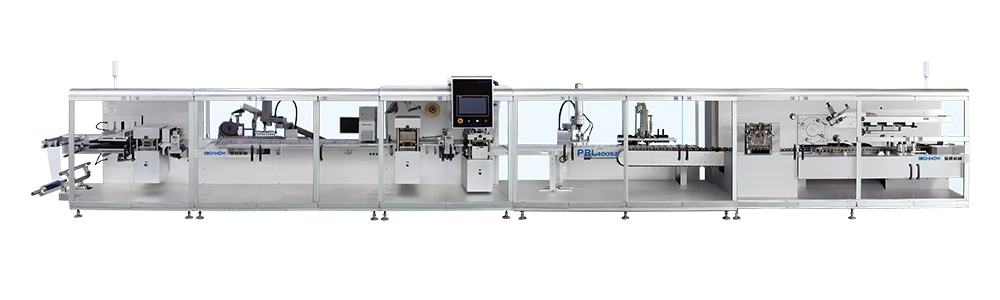
A cleanroom for a vial blister packaging line is usually drawn before the machine is ordered and approved after it is installed, which is the wrong order for both. The room drawing fixes where the walls sit, where the airlocks open and how the services enter; the machine then has to live inside those decisions. Get grade, airflow and cascade right, and the layout follows. Get them wrong, and no amount of commissioning air balancing recovers the room.
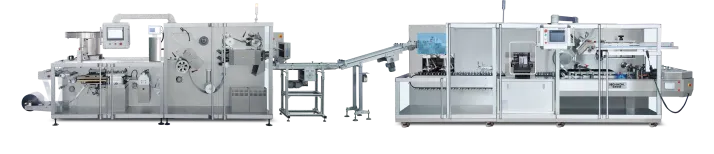
The three numbers are not independent. A higher grade needs more air and a tighter cascade, which needs more plant room and more fan energy. Each step up in grade is paid for twice, once in the HVAC and once in the qualification work that follows it. That is why the first question is not which grade the room should be, but which parts of the process genuinely need which grade.
Which grade the line actually needs
Grade is a function of exposure, not of equipment category. A sealed glass vial that has already been sterilised and is being placed into a blister cavity is not an open product. The room is protecting the package and the container surface, not a sterile product boundary. That is why most vial blister lines packing terminally sterilised product run in Grade C or Grade D, and why the same machine installed in an aseptic filling suite would be a different project altogether.
The inputs that settle it are few, and all of them are available before a quotation is requested.
| Input | Options | Effect on the room |
|---|---|---|
| Product state at the packing station | Sealed, already sterilised | Grade C or D is the usual home |
| Open, stoppering not complete | Grade A or B locally; the blister line is not the critical zone | |
| Sterilisation route | Terminal sterilisation in the final container | Packing is a secondary operation |
| Aseptic processing, no terminal step | Environmental control becomes product-critical | |
| Integrity risk in handling | Damage can create a leak path | Adds particle and bioburden control at handling |
| Downstream scope | Cartoning in the same room | One grade for the whole line |
| Cartoning behind a wall | Two grades plus a transfer | |
| Local regulation | EU GMP Annex 1, China GMP Annex 1, 21 CFR 211 | Fixes mapping and monitoring obligations |
The decision is the qualified person's and it belongs in the site's contamination control strategy, not in the machine specification. The supplier's job is narrower and more concrete: make the machine cleanable, and state the surfaces, gaps and heat loads the room has to absorb.
ISO class mapping, and what it means on the line
Grades are translated into particle counts by ISO 14644-1, and the translation is fixed. What varies is whether the class is claimed at rest or in operation, and that is where room designs get caught.
| Grade | ISO 14644-1 at rest | In operation | Where it lands on a blister line |
|---|---|---|---|
| A | ISO 5 | ISO 5, local zone | Only over an open container or a critical surface |
| B | ISO 5 | ISO 7 | Around an aseptic filling point; rarely on a blister line |
| C | ISO 7 | ISO 8 | The usual home for the machine on terminally sterilised vials |
| D | ISO 8 | Not specified in operation | Cartoning, case packing and the area behind the wall |
Two practical consequences follow. A Grade C room is normally classified at rest and monitored in operation, so the particle counts taken while the line is running are the ones that decide whether the design survives. And the machine must not be the particle source that pushes the room out of class, which is the subject of the section after the next one.
Airflow: where unidirectional flow pays and where it is waste
Unidirectional airflow is expensive because it moves a large air volume through a small face area. On a blister line it belongs over the points where a container is open or a critical surface is exposed, and almost nowhere else. Over a closed vial entering a cavity, turbulent dilution ventilation does the same job at a fraction of the energy.
Where a local unidirectional zone is specified, the reference value in EU GMP Annex 1 for Grade A is 0.45 m/s plus or minus 20 percent measured at the working position, with the condition that the flow is demonstrated to be unidirectional by the airflow visualisation test described in ISO 14644-3. A diffuser that reads 0.45 m/s at one probe and recirculates at its edges is not a unidirectional zone, whatever the instrument says.
Room air change rates are design practice rather than a single regulatory figure. Grade C and D rooms are commonly designed in the 20 to 40 air changes per hour band and Grade B substantially higher, but the number that matters is the recovery time after a disturbance, and that is a test rather than a calculation. Size the air for recovery, then accept whichever air change rate falls out of it.
Pressure cascade: cheap to draw, first to fail
The cascade is the cheapest part of the design and the one that fails first. Its logic is simple: the cleanest room holds the highest pressure and each step down leaks outward, so air travels from clean to less clean and never the other way. A step of 10 to 15 Pa between adjacent grades is the usual design value; below about 5 Pa the difference sits inside the noise of most sensors and of ordinary door movement.
| Room | Function | Pressure | Reference | Monitoring |
|---|---|---|---|---|
| Blister room, Grade C | Forming, sealing, carding | +30 Pa | Cartoning room | Differential transmitter with alarm |
| Transfer tunnel | Product between grades | +25 Pa | Cartoning room | Transmitter plus local gauge |
| Cartoning room, Grade D | Cartoning, leaflet, checkweigh | +20 Pa | Personnel corridor | Differential transmitter with alarm |
| Personnel corridor | Access and gowning | +10 Pa | Unclassified area | Logged, not alarmed |
| Unclassified area | Technical and dispatch | 0 Pa | Atmosphere | None |
Two failure modes recur. First, the cascade is designed for doors closed and proved with doors closed; when an operator holds a door for forty seconds the room behind it loses its margin and the particle counts at the far end move. Second, the machine's own exhaust changes the balance: a blister line pulling air for cooling or for dust extraction can flatten a 10 Pa step without anyone noticing until the first in-operation monitoring. Both are commissioning findings, and both are cheaper to solve by designing the transfer as a tunnel than by adding another supply fan.
Heat, dust and static: three loads the machine adds to the room
The machine adds three loads to the room, and each of them is quoted by a different party.
Heat. Forming and sealing are the heat sources. The sensible load they add has to be taken out by the room's cooling coil, and the figure has to come from the machine builder rather than from the HVAC contractor's rule of thumb. When it is missing from the design the room runs warm, an operator props a door, and the cascade pays for it. Local exhaust at the sealing station removes part of the load and part of the odour, and it then has to be balanced against the room pressure instead of fighting it.
Dust. Film trimming and card cutting produce particles that the room has to dilute. The design response is extraction at the source and a guard that keeps the scrap path away from the product path, not a larger fan downstream.
Static. Plastic film running over rollers charges, and a charged surface collects the particles that a laminar diffuser will then push straight down onto it. Ionisation bars at the film path and grounded rollers are machine features: they belong in the machine specification, not in the room drawing.
Layout: one room or two
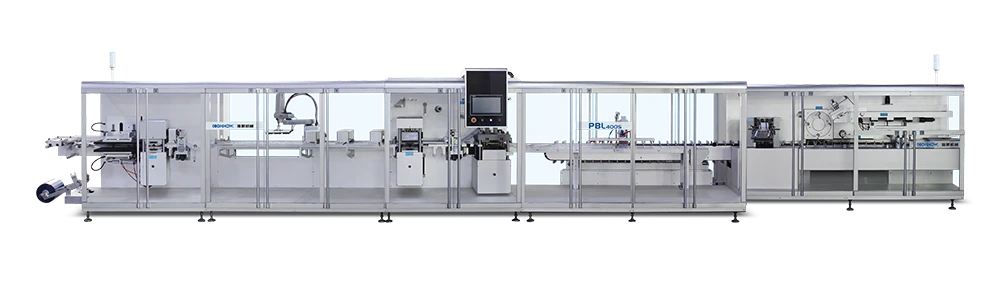
The single most expensive layout decision is whether the blister machine and the cartoner share a room. One Grade C room is simpler to qualify and cheaper to build, and it also means that the cartoner's downtime, its board dust, and its changeover all happen inside the cleanest space on the site.
Splitting the line puts the transfer across a wall: blister room at Grade C, cartoning at Grade D, a tunnel or a pass-through between them. The cost is a second room, a second cascade and a tunnel that has to be cleaned; the benefit is that the cartoning machine stage can be staffed, cleaned and changed over without disturbing the blister room's classification. For a line that runs a few formats at high volume, the split is usually worth it. For a line that changes format every shift, the tunnel becomes the bottleneck, and the split is a liability.
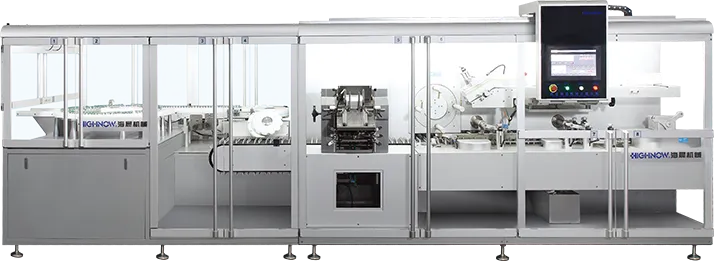
Whichever way it goes, the transfer deserves the same specification as a machine station: height, direction, accumulation and what happens when the cartoner stops. A transfer that backs up into the blister machine's outfeed converts a room design problem into a breakage problem, and breakage is the one cost that follows the product all the way to the customer.
Interface responsibility: the gap where commissioning time disappears
Time is lost in the gap between a machine supplier and a cleanroom contractor, usually through an assumption that the other party is providing the wall sleeve. The matrix below is the one to attach to both purchase orders.
| Interface item | Line supplier | Cleanroom contractor | Owner |
|---|---|---|---|
| Wall opening and sleeve | Opening dimensions, flange detail | Builds opening, seals and finishes | Approves the drawing |
| Transfer tunnel or pass-through | Interface height, direction, accumulation | Fabricates, installs, seals | Owns the operating procedure |
| Machine feet and floor | Foot positions, point loads | Floor finish, plinths | Accepts the installation |
| Compressed air | Consumption, required quality class | Piping to the point of use | Validates the air quality |
| Dust and cooling exhaust | Flow and connection size | Duct to the point, balances the room | Confirms pressure impact |
| Drain and cleaning points | Position, flow, temperature | Floor drain, trap, slope | Cleaning validation |
| Differential pressure sensors | None | Installs, calibrates, alarms | Sets limits and response |
| Cleaning access and clearances | Machine surfaces, guard removal | Room clearances, storage | Writes the procedure |
Cleanability is a machine question before it is a room question
A Grade C room cannot compensate for a machine with flat tops. Horizontal surfaces collect particles and resist wiping, so the specification asks for sloped covers, removable guards, no exposed threads and no gap wider than a wipe can reach. Stainless grade is a separate argument: 304 is adequate for dry areas and 316L where chlorinated detergents or product contact are involved, and it is better written into the order than debated at acceptance.
Two details matter more than they look. The first is whether the film path can be reached for cleaning without dismantling the forming station, because a guard that takes twenty minutes to remove is a guard that gets a compromise instead. The second is how scrap and reject bins leave the room: a bin that exits through the room door is a door that stays open, and an open door is a cascade that no longer exists.
Monitoring and qualification: where the room and the line meet
The room and the line are qualified on separate tracks that have to join. The room is classified to ISO 14644-1, monitored under ISO 14644-2 and tested under ISO 14644-3 for particle count, airflow and pressure differential; the line is qualified through IQ, OQ and PQ. The join is the in-operation particle and viable monitoring with the line running at rate, because that is the only state in which both designs are tested together rather than separately.
Two rules make that join survivable. Put monitoring points where the machine actually disturbs the air, not only on the grid the classification standard asks for. And write the alarm response before the alarm exists, because a pressure alarm at three in the morning needs a documented action rather than a phone call, and the quality documentation should name the person who owns each alarm.
Six failures that appear at commissioning
| Failure | Underlying cause | Consequence | Cheapest fix point |
|---|---|---|---|
| Cascade collapses when a door is held | Design assumes doors closed | Particle excursions at the far end | Room design: a tunnel instead of a door |
| Room cannot hold class with the line running | Machine dust and heat left out of the load | Re-balancing, extra terminals | Machine specification |
| A 5 Pa step reads as zero | Sensor range and door movement | False alarms that get ignored | Room design: 10 to 15 Pa steps |
| Transfer backs up into the outfeed | No accumulation specified | Breakage and unplanned stops | Machine specification |
| Cleaning outlasts the shift | Flat surfaces, guarded film path | Repeated deviations | Machine design |
| Extraction flattens room pressure | Exhaust not balanced against supply | Slow drift out of class | Commissioning sequence |
What to issue before the HVAC tender
The room package is ready when these twelve items exist, and most of them are cheaper to produce than to discover later. The container drawing, the nest drawing and the available blister lines for vial product configurations come first, so that the room is drawn around the machine that will actually be installed.
- Final grade for each zone, signed off by QA.
- Particle class at rest and in operation for each zone.
- Airflow type per zone, and the position of any unidirectional zone.
- Air change rate or recovery target, and the test that proves it.
- Pressure cascade table with the reference room for each step and the alarm limits.
- Heat load and dust extraction figures from the machine builder, not from a rule of thumb.
- Wall opening dimensions and the sleeve responsibility.
- Transfer tunnel geometry, including accumulation.
- Service list with quality classes, compressed air first.
- Cleaning access and the route by which bins leave the room.
- Monitoring point map, with points where the machine disturbs the air.
- Alarm response procedure, written before the alarm is enabled.
If the room is already drawn, send the room layout and container drawing to our engineers before the machine specification is frozen. It is far easier to move a sensor or a diffuser than to move a wall.
Frequently asked questions
What ISO class does a vial blister line need?
For sealed, terminally sterilised vials the line is normally placed in Grade C or Grade D, which maps to ISO 7 or ISO 8 at rest under ISO 14644-1. Local unidirectional protection is added only where a container is open or a critical surface is exposed. The final grade is a QA decision recorded in the site's contamination control strategy.
Does the blister machine have to share a room with the cartoner?
No. Splitting the line puts the blister machine in Grade C and the cartoner in Grade D with a transfer between them. The split costs a second room, a second cascade and a tunnel to clean, and it buys a cartoning stage that can be staffed and changed over without disturbing the blister room.
How many air changes per hour does a Grade C room need?
There is no single regulatory figure. Grade C and D rooms are commonly designed in the 20 to 40 air changes per hour band, with higher rates for Grade B, but the design target should be the recovery time after a disturbance, which is verified by test rather than by arithmetic.
How much pressure difference should there be between rooms?
10 to 15 Pa between adjacent grades is the usual design step, with the cleanest room at the top of the cascade. Below about 5 Pa the reading is inside sensor noise and door movement, and an alarm that trips without meaning quickly becomes an alarm nobody reads.
Can the blister line's heat overload the room's HVAC?
It can, because forming and sealing are continuous heat sources and the sensible load has to be removed by the cooling coil. Ask the machine builder for a load figure, add local exhaust at the sealing station, and verify the result at operational qualification with the line running at production rate.
Should the cleanroom be designed before the machine is ordered?
Yes, at least to the level of wall positions, penetrations and the transfer. Those three decide the machine's layout options and its guarding, and changing them after the frame is built is the most expensive kind of late change on a packaging project.
Conclusion
The room is not a shell around the line; it is a set of numbers the line has to live inside. Grade follows the product's exposure, airflow follows the grade, and the cascade follows both. Deciding those three before the layout costs a meeting and saves a rebuild.
This article covers the room half of the decision. The engineering and procurement guide for the line covers the other half: how capacity, nest, film, and validation are fixed before a supplier is asked to quote.