English
 Pусский
 Español
Changeover time is not a machine property; it is a definition plus a kit. Define it from the last good pack of the old format to the first good pack of the new format released, including clearance and first-article check, then split the work: everything that can happen while the line still runs moves outside the stop. What remains is a nine-step internal sequence of about 43 minutes, and it only holds if the format kit needs no adjustment and every part is at the line before the stop.
Why the number on the sales sheet is not the number in the shift
Ask three people on the same line how long a changeover takes and you will get three numbers, all measured from a different moment. One starts when the machine stops, one starts when the last pack leaves the outfeed, one starts when the operator picks up the first tool. None of them includes the paperwork, and all of them end somewhere convenient.
A changeover number is only useful if the boundaries are fixed, because the boundary is where most of the hours hide. The definition worth adopting is the one that matches how the plant is planned: last good pack of the previous format, through clearance, tooling, film, parameters, first article and release, to the first good pack of the new format running at rate. Everything inside that span is cost the planner has to book.
Once the boundary is honest, the economics become visible. On a 100,000-vial batch that runs about 12.5 hours at 8,000 vials per hour, a 43-minute changeover takes roughly 5 percent of the run time while a four-hour changeover takes roughly 32 percent. Run that batch once a week and the difference is close to 3,300 minutes a year, which is about 55 hours, or seven shifts, of capacity that never appears in a quotation. The existing analysis of changeover as a cost driver converts those minutes into money; this article is about how the minutes are removed.
Fixing the boundary before touching the machine
The first SMED exercise is an argument about scope, not about tooling. Write the elements down and mark which of them the plant is willing to count. Most sites discover that their recorded changeover time is the machine element only, and that the clearance and release elements, which sit either side of it, are booked as production or as quality, so nobody owns them.
| Element | Counted | Reason |
|---|---|---|
| Last good pack of the old format | Start | The outfeed must be empty before the new format can start |
| Removal of residual vials and film scrap | Yes | A cavity left with a broken vial is a later reject, not a saving |
| Tooling and format parts exchange | Yes | The machine element everybody already counts |
| Line clearance and record reconciliation | Yes | The line cannot legally restart until it is signed |
| First article pack and check | Yes | The first pack is usually scrap and always inspected |
| First article release | Yes | Unreleased output is not saleable output |
| Kit staging, documents, next format parts | No | External: it happens while the line is still running |
| Preventive tasks done during the stop | Separate | Book them separately or they will be hidden inside the changeover |
The last row is the one that keeps the exercise honest. Cleaning a punch that has run for a week is maintenance, and folding it into the changeover number makes the changeover look bad and the maintenance look free.
The internal and external split
SMED in one sentence: move work out of the stop. Nothing that can be prepared while the line still produces should wait for the stop, and nothing that requires the machine to be stopped should be done while it runs.
External work on a vial blister line is more than people expect. The next format kit can be staged at the line and checked against a list. The batch record can be opened. The film roll can be brought to the machine and warmed. The automatic cartoning machine format parts can be laid out in fitting order. The cleaning materials and the scrap container can be positioned. The first-article check sheet can be printed. Each of these is minutes, and together they are the difference between a 43-minute internal sequence and a two-hour one.
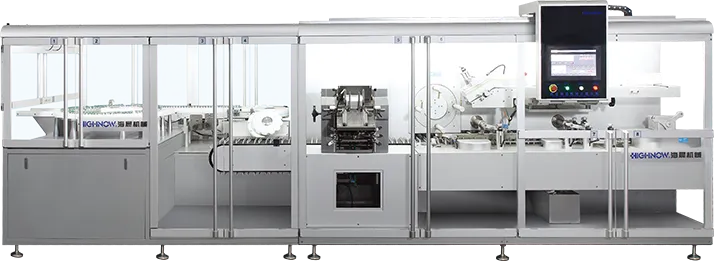
Internal work is everything the machine has to be stopped for, and there the aim is not speed of hands but elimination of adjustment. A fitter who is fast at aligning a punch is still losing ten minutes; the fix is a locating pin that removes the alignment.
The nine-step internal sequence, and what it adds up to
The sequence below is the internal part only, written for a line that packs vials into blister cards and cartons them. The minutes are a target allocation rather than a claim: they are the budget a project team can hold a supplier to, and they only become real after three measured changeovers.
| Step | Element | Type | Target | What usually eats the time |
|---|---|---|---|---|
| 1 | Last pack out, outfeed cleared, line stopped | Internal | 3 min | Waiting for someone to witness the last pack |
| 2 | Residual vials, film scrap and punch area cleared | Internal | 5 min | Scrap trapped behind guards and below the punch |
| 3 | Old tooling removed: nest, punch, channels | Internal | 6 min | Bolts where clamps were designed for |
| 4 | New format kit fitted | Internal | 11 min | Incomplete kit, then adjustment by trial |
| 5 | Film roll changed and threaded | Internal | 4 min | Threading the forming path by hand, twice |
| 6 | Recipe recalled, parameters confirmed | Internal | 3 min | No recipe, so values typed from a printed sheet |
| 7 | Cartoner format parts, leaflet, coding set | Internal | 4 min | Format parts stored in the warehouse, not at the line |
| 8 | Dry run, first article packed and checked | Internal | 5 min | First article rejected twice before it passes |
| 9 | First article released, record closed | Internal | 2 min | Signature chased across the building |
43 minutes is the sum of the target column. Whether the line hits it depends almost entirely on steps 4 and 8, which is also where the money is: an incomplete kit or an adjustment that has to be discovered at the first article will cost more than every other step combined.
Format kit design is the real lever
Most of the achievable saving is designed, not performed. A kit that locates on pins and needs no adjustment converts a skilled alignment task into a physical action that any trained operator can repeat. A kit held by bolts converts a two-minute action into a fifteen-minute one, every time, for the life of the line.
| Feature | Conventional | Quick change | Effect on the stop |
|---|---|---|---|
| Tooling retention | Bolts and shims, realignment needed | Clamps or eccentric locks plus locating pins | Removes the alignment step and the tool search |
| Positioning | Visual alignment by experience | Hard stops and pins, no adjustment | Removes trial-and-error first articles |
| Air and vacuum connections | Individual fittings, swapped one by one | Multi-coupling with coded ends | Removes cross-connection and leak checks |
| Identification | Stamped part number only | Format number plus colour coding | Cuts wrong-part fitting and searching |
| Storage | Warehouse, requested per change | Line-side trolley, one format per trolley | Makes staging external and complete |
| Wear parts | Changed when they fail | Listed as kit items with a replacement interval | Prevents improvised machining during a stop |
Two questions test a kit design faster than any drawing review. Can the kit be fitted with the guards in place? If not, the guards come off every changeover and the stop grows by the time it takes to refit them. And can a second person work on the other side of the machine at the same time? A kit that only one person can reach turns every changeover into single-handed work.
Standard work: who does what, in which order
A measured changeover is a choreography, and the choreography has to be written before it can be improved. The usual division on a blister line is two people: one on the vial blister packaging machine tooling and film, one on the cartoning machine format parts and the documentation. A third, usually QA, appears only at the first article. Written as a work combination sheet with three lanes and a time axis, it shows immediately where two people wait for each other.
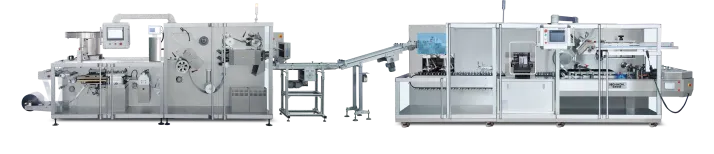
The document itself matters less than its form: photographs of each step at the actual machine, a kit checklist with the parts laid out in fitting order, and the parameter values per format rather than a paragraph of instructions. A work instruction that an experienced fitter can follow is not a work instruction; the test is whether a trained operator who has never run that format can follow it.
Training then follows the document rather than the other way round. Three changeovers are measured, the two slowest elements are attacked, and the sheet is revised. A changeover programme that starts with a stopwatch and ends with a target, without revising the sheet, produces a number that decays within a quarter.
Clearance, records and the first article
The compliance elements are the ones most often left outside the timer and most often responsible for the real elapsed time. Line clearance is a physical check and a signature; the batch record has to be closed for the old format and opened for the new; the first article has to be inspected against the specification, not against the previous pack on the bench.
None of these can be moved entirely outside the stop, but most of them can be prepared outside it. The record can be opened and the reconciliation form printed while the line runs. The first-article inspection sheet, with the dimensions and the visual criteria for that format, can be ready before the stop. What remains inside is the signature and the inspection, and those are two minutes if the paperwork was prepared and twenty if it was not.
The quality documentation should carry the format-specific first-article criteria, because a generic sheet invites a generic answer. If the criteria for the new format are not on the sheet, the inspector improvises, and the improvement programme inherits the variation.
Measuring without turning the shift into an audit
Measure three runs, element by element, with the same boundary every time, and publish the element list rather than a single number. A single number invites argument about the boundary; an element list invites a decision about which element to attack next.
Then stop measuring for a while. Continuous stopwatch observation changes behaviour in ways that flatter the number and hide the problem, and operators who are watched time the watch rather than the work. Three runs quarterly, plus the element list on the board, is enough to know whether the standard is holding.
Two indicators are worth keeping alongside the minutes: the number of first articles rejected, and the number of changeovers that needed a part fetched from outside the line. Both are leading indicators of the next slow changeover, and both are cheaper to fix than the stop itself.
Five failures that survive the first programme
| Failure | Cause | What it looks like | Fix |
|---|---|---|---|
| The number improves, capacity does not | Timer started at the stop and ended at the dry run | A pretty figure and unchanged output | Re-fix the boundary with clearance and release inside |
| The kit is never complete | No checklist, parts held in the warehouse | Stop begins with a search | Line-side trolley and a photographed checklist |
| Parameters typed by hand | No recipe management, no access control | Every changeover drifts a little | Recipes per format, values locked, changes logged |
| First article rejected twice | Adjustment designed into the kit | Five minutes becomes twenty-five | Locating pins and hard stops, no adjustment |
| Two people waiting on each other | No work combination sheet | One works, one watches | Lane plan with a shared time axis |
What to put in the machine specification
Changeover performance is bought, not improvised. The specification lines below are short, and each of them removes a category of stop that would otherwise be discovered in the first month of production.
- Number of format kits included, stated per format rather than as a total.
- Tooling retention method: clamps or locks with locating pins, no shimmed alignment.
- Multi-coupling for air and vacuum, with coded ends and a leak-free connection.
- Recipe management per format, with access control and a change log.
- Line-side storage for the kit, sized for the formats actually planned.
- Guards removable in under a minute, or designed so the kit can be fitted without removing them.
- Two-sided access to the tooling area so two people can work at once.
- A changeover demonstration at acceptance, on a real format pair, timed and recorded.
- A written element list from the supplier, matching the plant's own boundary definition.
- First-article criteria per format, supplied with the kit rather than after commissioning.
If the format list is still open, compare it with the available blister lines for vial product configurations and send your format list and container drawings to our engineers before the specification is frozen: the kit design follows the formats, and a locating pin is much cheaper to design than to add to a finished machine.
Frequently asked questions
Where does changeover time start and end?
Start at the last good pack of the previous format and end at the first good pack of the new format released for production. Clearance, tooling, film, parameters, first-article inspection, and release all sit inside that span. Any narrower definition produces a number the planner cannot use.
Is a 45-minute changeover realistic on a vial blister line?
It is realistic when the formats are in the same family, the kit locates without adjustment and everything is staged before the stop. A change involving a different film structure, a different nest pitch and a cartoner rebuild is a different project. The honest way to answer is to measure three changeover elements by element and compare the element list with the target allocation.
What is the first thing to do in a SMED programme?
Write the element list and fix the boundary before touching any tooling. Most of the recoverable time is in work that was never counted, such as clearance, documentation and the first article, and in parts that were never at the line when the stop began.
Should one person or two do the changeover?
Two, split by machine side, with QA joining only for the first article. A single person cannot work on the blister tooling and the cartoner at the same time, and a kit that only one person can reach will always take longer than its budget.
How much of the changeover should be external work?
As much as can be prepared while the line still runs: kit staging, documents, film, cartoner parts, cleaning materials and the inspection sheet. On a well organised line, the external share is roughly half of the total elapsed time, and none of it appears in the internal sequence.
How do I get changeover performance into the purchase order?
Specify the number of format kits per format, quick-release tooling with locating pins, multi-couplings, recipe management, line-side kit storage and a timed changeover demonstration at acceptance on a real format pair. A demonstration on a single format proves nothing about the second one.
Conclusion
A changeover target is a design decision with a procedure attached. Fix the boundary so the number means what the planner thinks it means, move every preparable task outside the stop, and then spend the engineering budget on locating pins rather than on faster fitters.
This article is the changeover half of the line decision. The engineering and procurement guide for the line covers the other half, from capacity arithmetic to the validation chain that follows acceptance.