English
 Pусский
 Español
If you've been following pharmaceutical packaging over the past few years, you've likely noticed a familiar pattern: incremental improvements, slow material substitutions, and cautious adoption of new technologies. But 2026 feels different. Regulatory pressures—particularly the EU Packaging and Packaging Waste Regulation (PPWR)—are accelerating change. Digital health integration is moving from concept to reality. And manufacturers are realizing that sustainability and efficiency don't have to come at the expense of product protection.
For vial blister packaging—a format that must balance the fragility of glass containers with demanding barrier requirements—the stakes are particularly high. This guide examines five emerging technologies that are reshaping how vials are packaged, protected, and tracked in 2026.
1. Recyclable and Recycled-Content Blister Materials
For decades, pharmaceutical blister packaging has relied on multi-material laminates—PVC combined with PVdC, PCTFE, or aluminum—that provide excellent barrier properties but are virtually impossible to recycle. The materials that protect drugs from moisture and oxygen have also made blister packs a sustainability challenge.
What's changing in 2026:
The industry is moving toward mono-material solutions that can be recycled within existing waste streams. SÜDPACK Medica's PharmaGuard® concept, for example, is a PP-based blister solution that is fully recyclable and—according to an ISO 14040/44-verified life cycle assessment—has a significantly lower climate impact than conventional composite materials. The material is available in both transparent and white versions, free from phthalates, vinyl, PFAS, and halogens.
TekniPlex Healthcare has taken a different approach, introducing recyclable blister solutions across the moisture barrier spectrum. For mid- to high-moisture barrier applications, their Tekniflex® COC thermoformable blister films—paired with barrier PP lidding films—are recyclable within the PP #5 waste stream. For drugs that require minimal moisture barrier, polyester films and push-through lidding films are recyclable within the PETE #1 waste stream. The company has also introduced a pharma-grade blister film containing 30% post-consumer recycled content.
What this means for you:
Recyclable materials are no longer an aspirational goal—they are becoming a baseline expectation. While primary pharmaceutical packaging is exempt from PPWR's recyclability and minimum recycled-content rules when product quality is at stake, it remains subject to the regulation's mandatory minimization obligation. Adopting recyclable materials now positions your packaging for regulatory compliance and demonstrates environmental responsibility to increasingly sustainability-conscious stakeholders.
To understand how different blister packaging configurations accommodate emerging materials, explore vial blister packaging solutions designed for various barrier requirements.
2. High-Efficiency Cold-Form Blister Technology
Cold-form aluminum blisters have long been the gold standard for moisture-sensitive drugs. But traditional cold-form foils have a critical limitation: they cannot be drawn deeply without rupturing. This forces manufacturers to use larger cavities than necessary, increasing material consumption, packaging footprint, and logistics costs.
What's changing in 2026:
ACG Packaging Materials has introduced SuperPod™, a multi-layer laminate designed for superior cold-drawing capability. The technology can reduce blister cavity sizes by up to 39% in specific applications. By unlocking smaller cavities, SuperPod can increase the number of blisters produced per shot by as much as three times—effectively freeing up existing manufacturing capacity and lowering per-unit costs.
The technology is particularly relevant for high-count formats—such as 20-count vitamins and B-complex capsules—where traditional cold-form blisters become impractically large. It also performs exceptionally well for moisture-sensitive and oncology products, where reduced headspace and narrower cavity spacing help minimize gas and moisture exposure.
What this means for you:
Smaller cavities mean less material per dose, lower shipping costs, and reduced warehouse space requirements. For manufacturers running high-speed lines, SuperPod has already demonstrated performance comparable to standard cold-form materials—but with far greater forming capability. Importantly, the material is designed to work with existing equipment.
3. AI-Powered Visual Inspection and Quality Control
Traditional vision inspection systems have relied on rule-based algorithms that require extensive configuration for each new product. When formats change, setup can be time-consuming and error-prone. And for challenging defects—such as micro-cracks in glass or subtle seal imperfections—traditional systems often struggle.
What's changing in 2026:
Artificial intelligence is transforming quality control on blister packaging lines. SEA Vision's new Harlequin HQBlister+ integrates AI technologies to significantly improve detection of the most challenging defects. The system adapts more quickly to product variations, reduces setup complexity, and supports even less-experienced operators.
The AI Wizard—making its debut at Interpack 2026—simplifies configuration and daily operations. Meanwhile, Antares Vision Group is showcasing AI-powered blister fill control systems at Interpack 2026. Research published in the Journal of Real-Time Image Processing (2026) has also introduced lightweight adaptive networks specifically designed for high-speed pharmaceutical blister pack detection.
What this means for you:
AI-powered inspection catches defects that traditional systems miss—including micro-cracks that could lead to vial breakage downstream. Faster setup means less downtime during format changes. And with AI systems learning from both real and synthetic images, detection accuracy improves over time. The result: higher product quality, lower reject rates, and reduced reliance on highly specialized operators.
4. Smart Packaging and Digital Health Integration
Pharmaceutical packaging has traditionally been a passive container—designed to protect the product, display regulatory information, and nothing more. But as healthcare becomes increasingly digital, packaging is evolving into an active participant in patient care.
What's changing in 2026:
Connected blister packs are becoming a reality. Embedded sensors can monitor temperature, humidity, and dose removal. NFC and RFID tags enable authentication, traceability, and digital interaction via smartphones. QR codes provide instant access to product information, instructions, and patient education.
The smart pharmaceutical packaging market was valued at $2.5 billion in 2024 and is projected to reach $6.8 billion by 2033, growing at a CAGR of 11.5%. Packaging-integrated sensors—including blister sensors—account for the largest segment share at roughly 40–45% of regional revenue in 2026.
For vial applications, companies like Schreiner Group are developing smart blister wallets with up to 64 individual cavities, with therapy control technology integrated into the blister wallet—invisible to the user. Newel Health and Gerresheimer have also launched a strategic collaboration to support pharma companies in the era of integrated digital therapies.
What this means for you:
Smart packaging addresses one of the most persistent challenges in healthcare: medication non-adherence. By providing real-time feedback, reminders, and usage tracking, connected blister packs help patients take their medications correctly. For manufacturers, smart packaging enables real-world data collection and supports regulatory requirements for traceability and anti-counterfeiting.
For customized packaging configurations that accommodate smart features and digital integration, explore how vial packaging lines can be tailored to your specific requirements.
5. Robotic Automation and Gentle Product Handling
Vial packaging presents a unique challenge: glass containers are fragile, and breakage during packaging is costly. Traditional transfer systems—with their abrupt movements, drop heights, and glass-to-glass contact—can be a significant source of breakage.
What's changing in 2026:
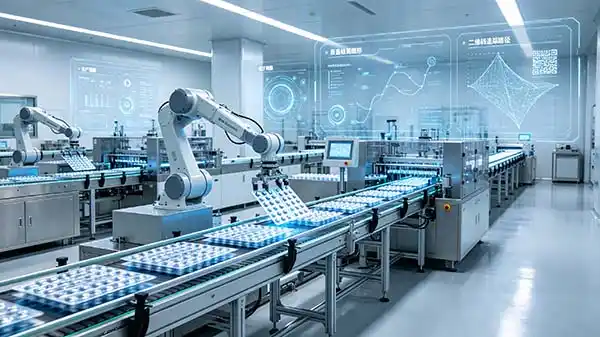
Robotic systems are transforming blister packaging lines with gentle, precise handling. Robot-assisted cartoning ensures gentle insertion of filled containers into blister nests without vibrations that could compromise product quality. Robotic arms move blister cards between stations with minimal impact. And automated feeding systems with vacuum grippers place vials into blister cavities with short drop heights—significantly reducing breakage risk.
According to industry analysis, end users are prioritizing digital connectivity and seeking real-time visibility into production metrics. Emerging technologies such as Internet of Things connectivity, cloud-based analytics, and machine learning algorithms are embedding intelligence into formerly mechanical processes, enabling adaptive control and predictive maintenance.
What this means for you:
Robotic automation reduces vial breakage—and the costly downtime that comes with it. Predictive maintenance capabilities mean you can address issues before they cause line stoppages. And with real-time production visibility, you can optimize throughput and minimize downtime.
How These Technologies Work Together
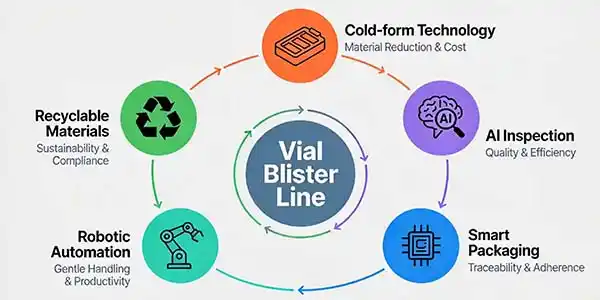
These five emerging technologies are not isolated developments—they are converging to create smarter, more sustainable, and more efficient packaging lines.
| Technology | Primary Benefit | Impact on Vial Packaging |
|---|---|---|
| Recyclable materials | Sustainability & compliance | Reduced environmental footprint; regulatory readiness |
| High-efficiency cold-form | Material reduction & cost savings | Smaller cavities, lower shipping costs, less waste |
| AI-powered inspection | Quality & efficiency | Catches micro-defects; faster changeovers; lower reject rates |
| Smart packaging | Patient adherence & traceability | Real-time tracking; patient engagement; regulatory compliance |
| Robotic automation | Gentle handling & productivity | Reduced breakage; predictive maintenance; real-time visibility |
Next Steps: From Trends to Implementation
Understanding these emerging technologies is the first step. The next is evaluating which ones align with your specific production needs, product portfolio, and regulatory requirements.
Key questions to consider:
-
Recyclable materials: Does your product require high-barrier protection that mono-materials can provide?
-
High-efficiency cold-form: Are you packaging moisture-sensitive products or high-count formats that could benefit from smaller cavities?
-
AI-powered inspection: Are your current inspection systems catching all defects—particularly micro-cracks and subtle seal issues?
-
Smart packaging: Do your products—or your patients—benefit from adherence monitoring or real-time data collection?
-
Robotic automation: Is vial breakage a significant source of downtime in your current operations?
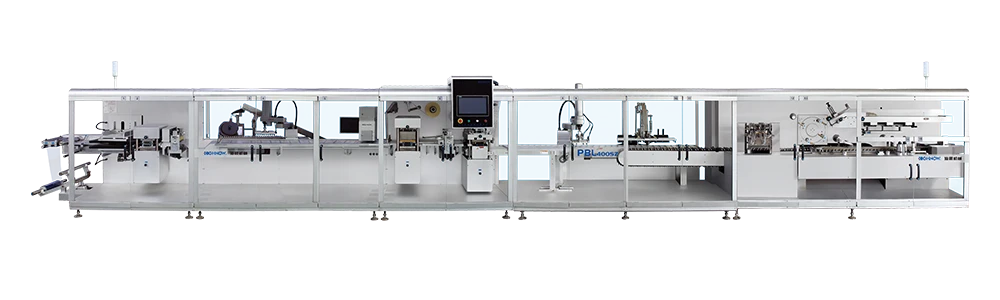
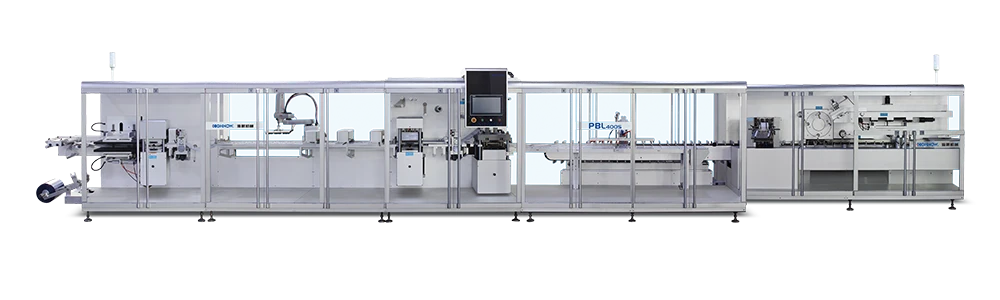
Once you have clarified these decision factors, comparing the specific capabilities of available packaging solutions becomes the next logical step. You can review HIGHNOW's vial blister packaging lines, which are designed to integrate with emerging technologies—from advanced inspection systems to flexible material handling—or explore customized configurations for specialized applications.
For additional technical resources on vial packaging line selection and operation, read our related guide on how vial blister packaging lines work.
Related Reading
-
How Does a Vial Blister Packaging Line Work? – A Step‑by‑Step Guide
-
What to Know Before Investing in a Vial Blister Line
-
Vial Breakage on Blister Lines? Causes and Fixes
-
Thermoforming Materials for Pharmaceutical Packaging: A Comparative Guide
-
5 Uses of Vial Blister Packaging in Pharmaceutical Manufacturing
This article is part of HIGHNOW's technical content library. No direct sales or pricing information is included. All technical discussions aim to help you make informed purchasing decisions.