English
 Pусский
 Español
The choice between PVC and Alu blister packaging for pharmaceutical vial products comes down to drug stability requirements, cost constraints, and regulatory timelines. PVC is cost-effective and widely used for stable products, while Alu offers near-hermetic protection for moisture-, oxygen-, or light-sensitive APIs at roughly 50% higher material cost. This guide compares both options across key decision factors.
Introduction: Why Material Selection Matters
Pharmaceutical blister packaging is not just a container—it is a scientifically engineered protective system designed to maintain drug quality throughout its shelf life. For vial products, ampoules, cartridges, and pre-filled syringes, the choice of blister material directly impacts product stability, regulatory compliance, and total cost of ownership.
Two material options dominate the pharmaceutical blister packaging landscape: PVC (polyvinyl chloride) and Alu (aluminum cold-form foil). While both are widely used, they serve fundamentally different purposes and are suited to different product profiles.
This guide compares PVC and Alu across six key dimensions to help you make an informed material selection decision.
What Is PVC Blister Packaging?
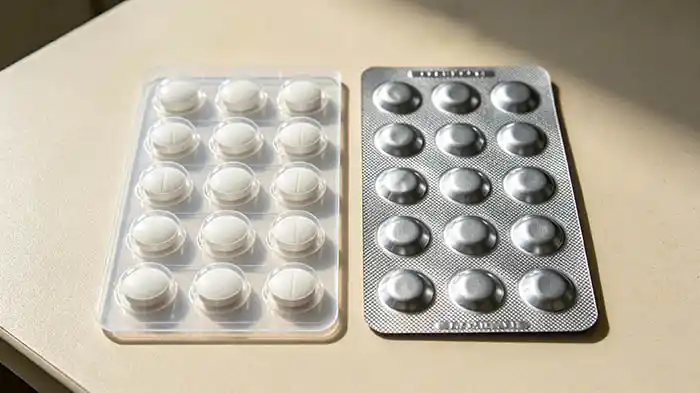
PVC (polyvinyl chloride) is the most widely used thermoforming film for pharmaceutical blister packaging. It is a transparent plastic sheet that is heated and formed into cavities using a thermoforming process.
Key characteristics:
- Transparent — allows visual inspection of the product
- Easy to form — requires heat but is simple to process
- Cost-effective — baseline material for blister packaging
- Compatible with aluminum foil lidding
Typical applications:
Standard oral solid dosage forms, OTC products, and pharmaceuticals with low to moderate sensitivity to moisture and oxygen.
What Is Alu Blister Packaging?
Alu (aluminum) blister packaging uses a cold-formed aluminum laminate to create blister cavities without heat. The material is opaque and metallic silver in appearance.
Key characteristics:
- Opaque — provides complete light protection
- Cold-formed — no heat applied during cavity formation
- Near-hermetic barrier — virtually zero moisture, oxygen, and light transmission
- Higher cost — approximately 50% more expensive than PVC-based blisters
Typical applications:
Moisture-sensitive, oxygen-sensitive, or light-sensitive APIs; products requiring extended shelf life; and drugs marketed in tropical or high-humidity climates.
Side-by-Side Comparison: PVC vs Alu
| Factor | PVC Blister | Alu Blister |
|---|---|---|
| Material cost | Lower (~$2.50/kg for PVC foil) | Higher (~50% more than PVC) |
| Moisture barrier (MVTR) | 4–6 g/m²/day | 0.02–0.05 g/m²/day |
| Oxygen barrier | Low | Excellent (virtually zero) |
| Light protection | None (transparent) | Complete (opaque) |
| Forming process | Thermoforming (heat required) | Cold forming (no heat) |
| Visibility | Transparent — product visible | Opaque — product not visible |
| Shelf life suitability | Short to medium | Extended |
| Climatic zone suitability | Temperate zones | All zones, including ICH Zone IVb |
| Recyclability | Challenging | Multi-layer material, also challenging |
When to Choose PVC
PVC is the appropriate choice when:
- The API is stable and not sensitive to moisture, oxygen, or light
- The product has a short to medium shelf life
- The product will be marketed in temperate climates
- Cost is a primary constraint
- Visual inspection of the product is required
Typical products:
Many oral solid dosage forms, OTC products, and stable generics.
Limitations to consider:
- PVC offers only basic moisture protection
- Not suitable for hygroscopic or highly sensitive APIs
- Environmental concerns: PVC releases harmful substances when incinerated and is difficult to recycle
When to Choose Alu
Alu is the appropriate choice when:
- The API is moisture-sensitive, oxygen-sensitive, or light-sensitive
- The product requires an extended shelf life
- The product will be marketed in tropical or high-humidity climates
- Maximum protection is required, even at higher cost
- The product is a high-value or controlled substance requiring tamper evidence
Typical products:
Hygroscopic APIs, oxygen-sensitive compounds, light-sensitive drugs, and products destined for Southeast Asia, Africa, or the Middle East.
Key advantage:
Alu provides a barrier of nearly 100% against both oxygen and water, enabling extended shelf life.
Beyond the Binary: The Mid-Range Option
Between PVC and Alu lies a middle ground: barrier-coated films such as PVDC-coated PVC or PVC/PCTFE laminates. These materials offer improved moisture and oxygen protection while retaining transparency and a lower cost than Alu.
Consider PVDC-coated PVC if:
- The API has moderate moisture sensitivity
- You need better barrier than PVC but cannot justify Alu cost
- Visual inspection is still required
Equipment Considerations
The choice between PVC and Alu also affects packaging line requirements:
| Consideration | PVC (Thermoforming) | Alu (Cold Forming) |
|---|---|---|
| Heat requirement | Yes | No |
| Forming pressure | Moderate | Higher |
| Tooling | Standard thermoforming tools | Specialized cold-forming tools |
| Line speed | Generally faster | Generally slower |
| Changeover complexity | Moderate | Higher |
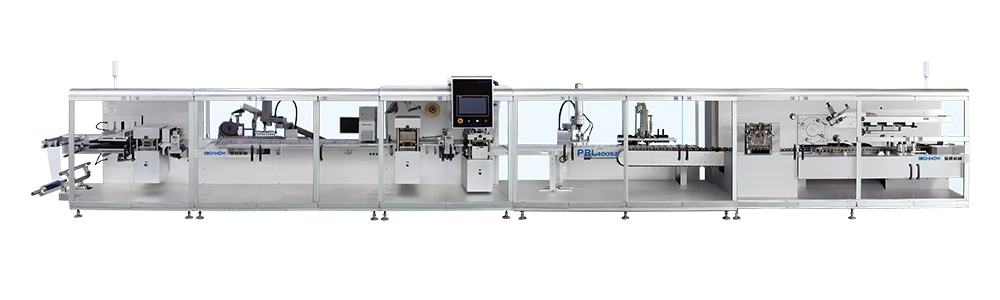
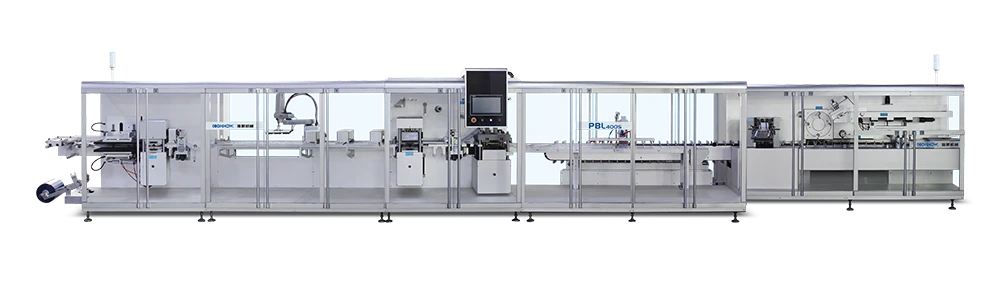
Not all blister packaging lines support both thermoforming and cold forming. When evaluating equipment, it is important to confirm with the supplier whether the line can handle your chosen material. For multi-product facilities running both PVC and Alu, changeover time and tooling compatibility become critical factors. To compare different line configurations for your material requirements, you can review the available options across the product range.
(https://youtu.be/HfbgdoHX5MA?si=iJCItAOheg1_ZSPV)
Decision Matrix: Which Material Fits Your Product?
Use this quick-reference matrix to guide your initial assessment:
| Product Characteristic | Recommended Material |
|---|---|
| Stable API, temperate climate, cost-sensitive | PVC |
| Moderate moisture sensitivity | PVDC-coated PVC |
| High moisture/oxygen sensitivity | Alu |
| Light-sensitive API | Alu |
| Extended shelf life required | Alu |
| Tropical climate | Alu |
| Visual inspection required during packaging | PVC or PVDC-coated PVC |
| High-value or controlled substance | Alu |
Frequently Asked Questions
Q1: Is Alu always better than PVC?
A: No. Alu offers superior protection but at a significantly higher cost. For stable APIs with short shelf lives in temperate markets, PVC is often the more economical and appropriate choice.
Q2: How much more does Alu cost compared to PVC?
A: Industry estimates place Alu blister packaging at approximately 50% higher cost per pack than conventional PVC-based blisters. The exact difference depends on material thickness, order volume, and regional pricing.
Q3: Can the same blister packaging line handle both PVC and Alu?
A: Not all lines support both. PVC uses thermoforming (heat), while Alu uses cold forming. Some lines offer dual-process capabilities; confirm with the supplier.
Q4: What is the Moisture Vapor Transmission Rate (MVTR) difference?
A: PVC typically passes 4–6 g/m²/day. Alu achieves 0.02–0.05 g/m²/day—approximately 100–200 times lower, making it the gold standard for moisture-sensitive products.
Q5: Are there environmental concerns with PVC packaging?
A: Yes. PVC contains chlorine and can release harmful substances when incinerated. It is also challenging to recycle in standard waste streams. These concerns are driving increased interest in alternative materials.
Q6: What is the mid-range option between PVC and Alu?
A: PVDC-coated PVC or PVC/PCTFE laminates offer improved barrier properties while retaining transparency and lower cost than Alu. These are suitable for APIs with moderate sensitivity.
Conclusion
The choice between PVC and Alu blister packaging is not about which material is "better"—it is about which material is right for your specific product and market.
Key takeaways:
- PVC is cost-effective, transparent, and suitable for stable APIs in temperate markets
- Alu offers near-hermetic protection for sensitive APIs at a higher cost
- PVDC-coated films provide a middle ground for moderate sensitivity requirements
- The decision should be guided by API stability data, not by preference or habit
- Equipment compatibility must be verified before committing to a material
Before finalizing your material choice, conduct stability studies with your actual API under the intended storage conditions. The data will tell you which material is required.
To explore blister packaging line configurations that support your chosen material, you can review the available options across the product range. For assistance with material selection and line compatibility, the engineering team is available for consultation.